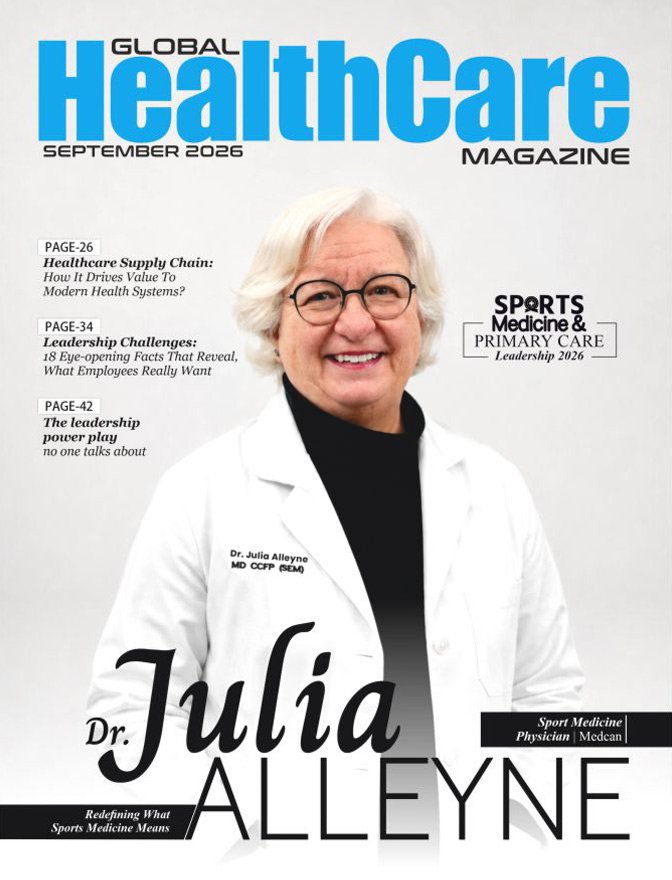
Winters in that Ontario neighbourhood arrived with a flooded rink in the park, kept ice-ready by a father who spent early mornings maintaining it, while summers meant pick-up soccer and a place on the school track team. None of it looked, from the outside, like the beginning of a career in medicine.
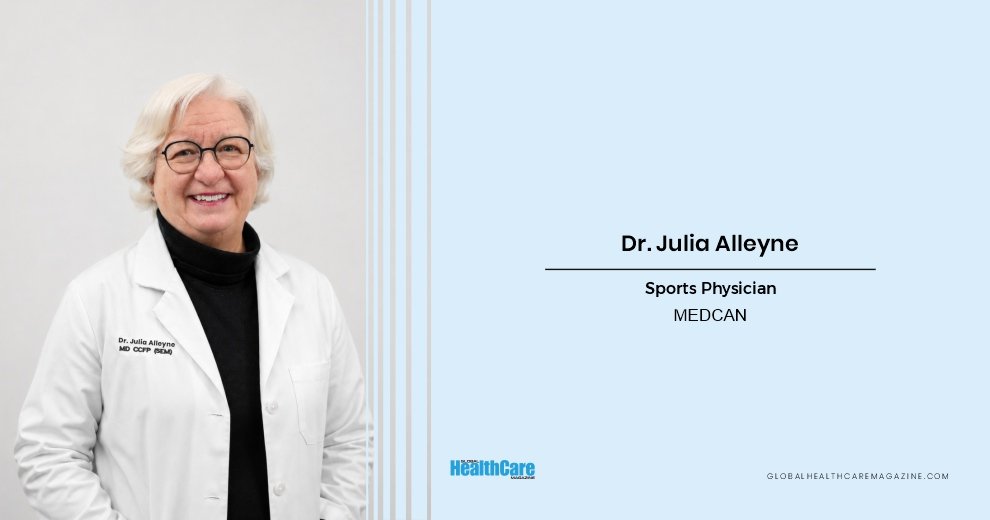
Today, Dr. Julia Alleyne practises primary care sports medicine at Medcan in Toronto and at the Rehab Pain Service at Toronto Rehabilitation Institute, University Health Network. She is also an Associate Professor at the University of Toronto’s Department of Family and Community Medicine and a medical consultant to the Ontario Ministry of Health. But she did not grow up dreaming of being an Olympic medical doctor. Medicine arrived serendipitously, through a broken bone that was not even hers.
A Fracture That Set a Course
Dr. Alleyne was in the eighth grade when her father sustained a comminuted tibial fracture during a family ski outing. What followed was a long recovery, and for her, an unofficial apprenticeship: she accompanied him to physiotherapy appointments, week after week, and there found her first real look at the profession that would eventually define her.
After high school graduation, she was accepted into the Mohawk College-McMaster University Physiotherapy program, at a time when most classmates arrived with university education already behind them. She spent four years working full-time in orthopaedics and sports medicine. She liked the treatment aspect of her work, but she wanted to understand how anatomy, physiology, and human behaviour worked together, and how disease and disability might be prevented. That curiosity sent her to McMaster University’s medical school, where she was admitted on her first application.
She was already married when she entered medical school, and her first child arrived just weeks after graduation. It was not until she was practising family medicine that she noticed something telling: most family doctors knew little about non-surgical musculoskeletal care, and her physiotherapy training had become a natural asset. Requests for consultations flowed in. Family medicine was broad enough to accommodate her many interests. She was accepted into a paediatric residency and declined it, though she later worked with children and youth, including at the Sport Medicine Clinic at the Hospital for Sick Children in Toronto. She also considered Physical Medicine and Rehabilitation and psychiatry, but found aspects of both within family medicine.
Building From the Ground Up in Oakville
For ten years, Dr. Alleyne practised grassroots family and sports medicine in Oakville, Ontario, where she opened Argus Sports and worked concurrently in student health services at Sheridan College. Working with community-level gymnasts, hockey players, and varsity athletes, she saw the growing impact of sedentary lifestyles and became involved in community speaking engagements on physical activity promotion.
That community experience helped shape a broader conviction: sports medicine could not be reserved for elite athletes. It had to help everyday people begin, resume, and sustain activity in their daily lives.
In 1991, she earned her diploma from the Canadian Academy of Sport Medicine, one of only a dozen women in Canada to do so at a time when sports medicine was heavily male-dominated.
First-of-its-Kind Clinic
In 1997, Dr. Alleyne founded Sport Care at Women’s College Hospital in Toronto, which she describes as the first clinic in North America dedicated to research and education in women’s sports medicine. For sixteen years, it operated as an interprofessional service integrated into primary care and became the birthplace of Athletes@Risk, a program aimed at preventing injuries and illness common among female athletes.
Sport Care also established her belief that research, education, and clinical care could reinforce one another rather than exist in separate lanes. The clinic offered consultations for women who wanted to remain active during pregnancy. Dr. Alleyne co-authored the CASEM Position Statement on Exercise and Pregnancy in 2007 and its 2008 discussion paper, precursor work to the 2019 Canadian Guideline on Physical Activity Throughout Pregnancy.
Her research into breast health led to a granted patent for a wrap-around sports bra on May 30, 2000. A prototype was developed, but the cost of bringing it to market proved prohibitive, and it has yet to reach store shelves.
Teaching ran alongside her clinical work. At the University of Toronto, she delivered lectures and clinical instruction from undergraduate to continuing education levels. In 2009, she completed a Master’s in Community Health specializing in Health Professional Teacher Education, beginning her work in e-learning and the development of online courses through MSK Courses of Canada, CASEM, the University of Toronto, the Workplace Safety and Insurance Board, and the Ontario Ministry of Health.
Since 2013, Dr. Alleyne has practised at Toronto Rehabilitation Institute in roles including Lead Physician, Outpatient Services, Research Physician in concussion care, and Physician with the Rehab Pain Service at the Toronto Academic Pain Medicine Institute. In 2022, she joined Medcan, drawn to its emphasis on health promotion and prevention.
The Patient Who Rewrote the Job Description
Running her Oakville clinic between 1990 and 2002, Dr. Alleyne once told her receptionist, Shirley, to book only sports medicine patients. When Shirley asked how she would know who qualified, Dr. Alleyne told her, “Ask them if their injury happened during sports.”
The next day, Shirley took a call and arranged transportation for a man who had been injured during sports. The following day, Archie arrived using a walker. His date of birth was 1910. She asked about his sports injury. He pointed to his right knee. 1929, 3rd Quarter, U of T Football Finals, and it still hurts, he said.
Archie had never received good care for his injury, and that pain had progressed into advanced osteoarthritis. Dr. Alleyne told Shirley to book anyone who wanted help related to physical activity, regardless of age. She brought on two more doctors to meet the demand.
The experience changed her understanding of the word “sports.” It was too restrictive for a field that could serve anyone who wanted to move, exercise, recover, or remain active.
Treating the Whole Person
Dr. Alleyne’s clinical philosophy is rooted in primary care: direct access whenever reasonable and care delivered in the community. Most soft tissue musculoskeletal complaints, she points out, do not need an orthopaedic surgeon. Primary care sports medicine can address nutrition, mental health, hormone balance, cardiovascular prevention, and other factors alongside the injury itself.
An adolescent who comes in because of sports may, in her hands, also become an opportunity to discuss healthy lifestyle and prevention. “I care for the whole person,” she says, and that perspective shapes the treatment plan.
That philosophy was reinforced by another part of Dr. Alleyne’s career: working at the highest levels of elite sport, where recovery, prevention, and long-term function are inseparable from performance.
Five Rings, Five Lessons
Dr. Alleyne was selected to five Canadian Olympic teams: team physician for ice sports at Salt Lake City (2002), Assistant Chief Doctor and figure skating physician at Torino (2006), team physician for gymnastics and trampoline and wellness lead at Beijing (2008), figure skating physician and wellness lead at Vancouver (2010), and Chief Doctor for the Canadian team at London (2012).
As Chief Doctor for Skate Canada, she travelled to competitions for over a decade, supporting athletes from the junior levels to the Olympics. Her task was to optimize athlete health and turn their hard work into medal performances. She recalls that chapter as a privilege given that she was welcomed into the sport culture and learned so much from athletes and coaches.
From elite sport, she carried lessons into everyday medicine: build recovery into an activity plan; pace your activity progression and diversify your exercise plan; work backward from the end goal; and, when something goes wrong, park it and focus on the next challenge. As she puts it, “if it doesn’t challenge you, it doesn’t change you.”
Leading When the Stakes Were Highest
In 2007, Dr. Alleyne joined a thirty-person provincial government committee tasked with recommending ways to increase physical activity across Ontario. She was the only sports medicine doctor on the committee. After three meetings, the group reached one unanimous recommendation: bid for the Games to build sports infrastructure in the community.
In 2011, she was offered the role of Chief Medical Officer for the Toronto 2015 Pan and Parapan American Games. She calls it the hardest job she has done. The pay was low, the hours were long, and she had to recruit the volunteers needed to provide medical coverage. “The hard moments were many as I wrote my own job description and didn’t really know what lay ahead,” she recalls.
Six months before the Games, she took a leave from clinical work, hired additional leadership support, secured funding for two full-time administrative positions, and rallied volunteer recruitment. The Games brought more than 10,000 athletes and coaches, 100,000 spectators, and 30,000 volunteers. There were no deaths during the Games.
She also introduced innovations including therapy dogs in the athletes’ village, remote assessments using Bluetooth diagnostic instruments, embedded public health support for infection control, and a polyclinic that diverted less critical patients from hospitals. About 100 ambulance transports were diverted from hospitals during the Games.
Building a Team Around the Patient
Dr. Alleyne’s earlier leadership responsibilities included setting policy on patient eligibility, addressing patient concerns, evaluating service quality, and ensuring new hires were properly credentialed. Today, her role is to reimagine service delivery models to ensure they are interprofessional, patient-centred, and integrated into primary care.
Rather than thinking of care as a sequence of handoffs between professions, she sees the patient as the centre of a flexible circle of expertise. Physiotherapists, occupational therapists, chiropractors, massage therapists, athletic therapists, sports medicine physicians, orthopaedic surgeons, physiatrists, dietitians, trainers, psychologists, pharmacists, nurses, administrators, coaches, family members, and increasingly AI may all contribute, depending on what that individual needs.
“Each patient truly has their own team,” she says. The point is not to assemble the largest team, but the right one. Collaboration depends on trust, communication, shared records, case rounds, secure chat, and jointly developed care pathways.
Knowledge Built to Travel
Dr. Alleyne has presented and participated in research on nutrition and the female athlete and helped develop three primary care clinical tools: the CORE Back Tool, the CORE Neck Tool, and the OA Tool. She has also developed online and in-person courses through MSK Courses of Canada and other academic and professional organizations.
At the University of Toronto, her roles have included Program Director for Sport and Exercise Medicine, Program Director for Enhanced Skills, Associate Program Director for Graduate Studies, E-learning Lead, Internal Review Lead for Accreditation, and Master’s course instructor. She has mentored learners at all levels of education.
For her, the value of expertise lies partly in how far it can travel. A clinical lesson can become a teaching module; a recurring problem can become a clinical tool; a question from practice can lead to research that informs care beyond a single patient. Her work has repeatedly turned individual experience into resources other practitioners can use.
What Balance Actually Looks Like
Dr. Alleyne’s hobbies are numerous: hiking, cycling, yoga, skiing, crafts and sewing, reading and writing, history tours and museums, birdwatching, and bonsai. She credits her family with keeping her busy and approaches work-life balance simply: enjoy the work, prioritize family, leave some time for yourself, and maintain flexibility for the unexpected.
She reviews her schedule two weeks ahead and creates space when it starts looking too full. She also relies on delegation, trusting that others can do a good job.
For someone whose work has always centred on keeping people active, her own approach is similarly practical: build in flexibility, make room to recover, and leave enough space for life outside the schedule.
And when she needs complete relaxation, there is always the hot tub.
Taking Rehabilitation to the World
Dr. Alleyne now serves as a Steering Committee Member of the World Rehabilitation Alliance, taking the rehabilitation focus that shaped her early career to the global policy stage. The Alliance advocates for rehabilitation to be recognized and funded as an essential part of healthcare.
She also has an article forthcoming reviewing a global case compendium of primary care and examining the level of rehabilitation integrated into healthcare systems around the world.
That trajectory brings her career full circle, from sitting beside her injured father at physiotherapy appointments to helping shape how rehabilitation is understood at a global level. What began as a glimpse into one profession has become a lifelong commitment to helping people regain function, remain active, and keep moving forward.
Quotes