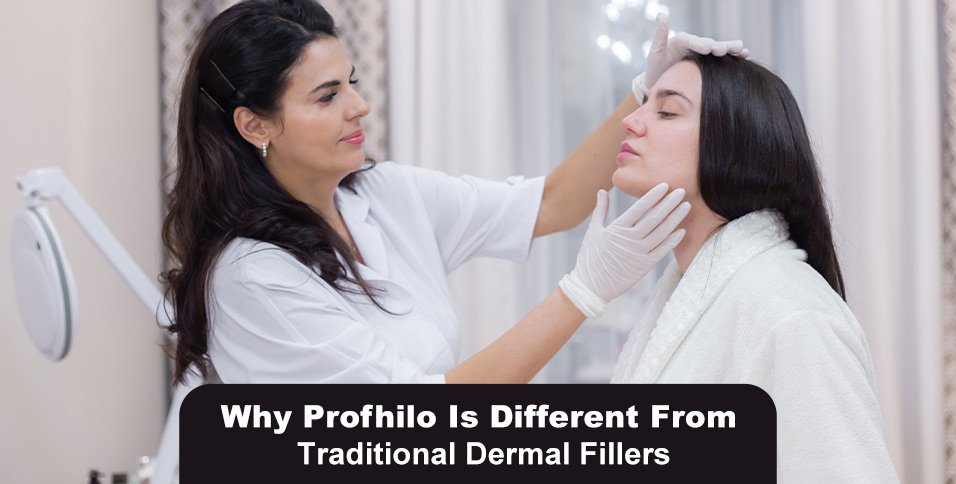
In aesthetic medicine, “injectables” often get grouped together as if they all do the same job. They don’t. The umbrella term is convenient, but it blurs an important distinction: some treatments are designed to replace lost volume, while others are intended to improve the quality of the skin itself.
That difference matters, especially for patients who say they want to look fresher, less tired, or simply more like themselves. In many cases, what they are noticing isn’t a need for bigger cheeks or fuller lips. It’s a change in skin texture, elasticity, and hydration that comes with age, stress, sun exposure, and natural collagen loss.
This is where Profhilo enters the conversation. It is frequently mentioned alongside dermal fillers, but that comparison can be misleading if it stops at “both involve hyaluronic acid injections.” The real story is more nuanced.
What Profhilo Actually Is
At first glance, Profhilo can sound like just another injectable hyaluronic acid treatment. But unlike traditional fillers, it is not primarily used to sculpt or volumise. Its purpose is different from the outset.
Not a Volumiser, but a Skin Remodeller
Traditional dermal fillers are typically cross-linked hyaluronic acid gels. They are formulated to hold their shape, which makes them useful for adding structure and definition. Think contouring the cheeks, projecting the chin, softening deep folds, or restoring volume in areas that have hollowed over time.
Profhilo, by contrast, contains a high concentration of hyaluronic acid in a formulation designed to spread beneath the skin rather than stay in one sculpted place. Instead of creating lift in a targeted area, it disperses more evenly and works as a bio-remodelling treatment. In practical terms, that means the goal is not to change facial architecture, but to improve the condition of crepey, lax, or dehydrated skin.
That distinction is why it often appeals to people who are curious about aesthetic treatments but hesitant about looking “done.” They may not want more volume. They want better skin.
Why Hydration Is Central to the Treatment
One of the most noticeable differences between Profhilo and filler is the kind of improvement patients tend to report. With filler, the result is usually structural: an area looks fuller, smoother, or more balanced. With Profhilo, the changes are often described in terms of glow, bounce, softness, and firmness.
That’s because the treatment is aimed at supporting skin quality from within. It is widely recognised as a clinically developed treatment for deep skin hydration, but hydration is only part of the picture. The formulation is also associated with stimulating collagen and elastin, two proteins that are central to skin resilience. In other words, it is not simply adding moisture; it is encouraging the skin to behave more like healthier, younger skin.
For patients with dullness, fine lines, thinning texture, or mild laxity, that can be a more relevant intervention than adding volume.
How Traditional Fillers Work Differently
Understanding fillers on their own terms makes the comparison clearer. Fillers are excellent tools when used for the right indication. They are not “worse” than Profhilo; they simply solve a different problem.
Fillers Restore Shape and Structure
As we age, fat pads shift, bone support changes, and soft tissue descends. This can create flattening in the cheeks, deeper nasolabial folds, and shadowing under the eyes. Dermal fillers are often chosen to address exactly those issues because they can replace volume where it has been lost.
A skilled injector uses filler strategically to support the face, sometimes in quite small amounts. The best results are rarely about making features larger. They are about restoring proportion and reducing the visual signs of structural ageing.
Profhilo cannot do that job in the same way. It does not have the same lifting capacity or shape-retaining behaviour. If someone needs stronger support in the mid-face, jawline, or temples, filler may still be the more appropriate option.
The Treatment Experience Is Different Too
There is also a practical difference in how the products are placed. Traditional fillers are injected into specific areas that require contouring or support. Profhilo is generally administered through a small number of carefully mapped injection points, allowing the product to diffuse through the tissue.
This matters because it reflects the treatment philosophy. Fillers are precise and localised. Profhilo is broader and more global in its effect.
Who Benefits Most From Each Approach?
The best treatment choice depends less on trends and more on the underlying concern. This is where thoughtful assessment becomes essential.
Someone who is dealing with:
- facial hollowness
- loss of contour
- deeper static folds
- a desire for more definition may be better suited to traditional filler.
Someone more concerned with:
- dehydration
- crepey texture
- fine lines
- skin laxity
- a tired or dull appearance may be a stronger candidate for Profhilo.
Of course, real faces are rarely that simple. Many patients have both structural and skin-quality concerns, which is why experienced practitioners often see these treatments as complementary rather than competing.
Why “Natural-Looking” Means Different Things
The phrase “natural-looking results” gets used constantly in aesthetics, but it can mean different things depending on the treatment. With filler, natural usually means proportionate enhancement or restoration that does not draw attention to itself. With Profhilo, natural often means there is no visible sign of augmentation at all, just skin that looks healthier.
Subtlety Can Be the Point
For some patients, that subtlety is exactly the appeal. They do not want comments about fuller cheeks or a sharper jawline. They want people to ask whether they’ve changed their skincare, slept better, or come back from holiday. Profhilo fits neatly into that category because the improvement is usually registered as overall freshness rather than a specific alteration.
That is also why it tends to attract a broad age range. Younger patients may use it as an early skin-quality intervention, while older patients may value it as a way to improve tissue quality without relying entirely on volumising treatments.
The Bigger Picture: Treatment Should Match the Problem
The most useful way to think about Profhilo versus dermal fillers is not in terms of which is better, but which is better suited to the issue being treated. If the problem is volume loss, use a tool designed for structure. If the problem is dehydration, laxity, and declining skin quality, a bio-remodelling approach makes more sense.
Confusion happens when every injectable is presented as interchangeable. They are not. A modern aesthetic plan works best when treatment goals are specific, realistic, and tailored to the tissue in front of you.
In that context, Profhilo stands apart from traditional dermal fillers because it addresses something fillers were never really built to fix: the overall health and behaviour of the skin itself.