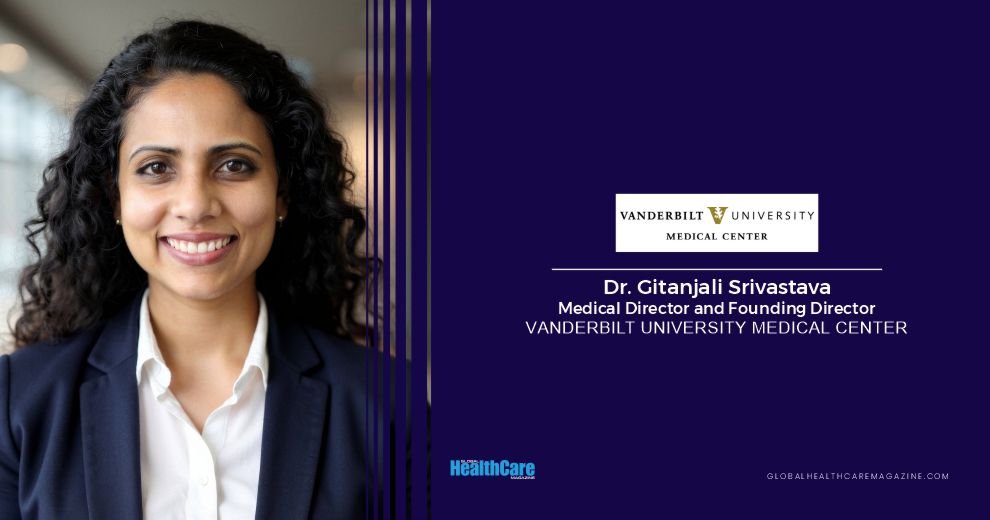
There is something quietly radical about a person who looks at a broken system and decides not to work around it, but to dismantle it with precision and rebuild it entirely from scratch. Dr. Gitanjali Srivastava is that kind of person. She is a physician, a scientist, an AI and machine learning engineer, a keynote speaker, and the Medical Director and Founding Director at Vanderbilt University Medical Center, leading one of the most ambitious programs in obesity medicine operating today.
She is, by almost any credible measure, a disruptor. But spend real time understanding her story, and what strikes you most is not the disruption. It is the discipline behind it.
The Education of a Disruptor
Dr. Srivastava grew up in what she herself describes as a “mediocre background,” a middle-class family with limited resources, but one thing she considers a true jewel: education. She came from a family of educators through and through.
Her mother, now retired, spent 23 years as a teacher in the United States public school system. Her late father was, in her words, a genius Professor in electrical engineering, a man who graduated from one of the top engineering institutions of his time. In the 1970s, he was a scholarship student who carefully saved pennies from his stipend to support his family and send money home to his mother to run the household.
That image lingers. A brilliant man counting coins so that the people he loved might have enough. It is the kind of origin story that does not produce people who take shortcuts, and it shows in everything Dr. Srivastava has built since.
She speaks of teaching as one of the most important roles in society, a conviction clearly shaped by watching her parents inhabit it with dedication. And it shows in how she leads today: she mentors, she builds cultures of curiosity, she creates, as she puts it, environments where innovation is “both disciplined and daring.”
The Question That Would Not Let Her Go
Innovation, Dr. Srivastava insists, does not arrive on cue. “Innovation is not something that is sparked; it finds you,” she says. “I found a problem in society that no one wanted to address, and I sought to change that.”
The seeds of that problem were planted long before medical school. In her middle school years, she and her friends would spend hours in conversation about philosophy: wellness, health, why babies are born crying, and what disease actually means. These were not typical adolescent conversations, but Dr. Srivastava was not, by any ordinary measure, a typical adolescent.
Then came medical training, and with it, her first patient. A baby. One she could not save despite intense resuscitation efforts. She was in her early twenties. And because she was the only one present who could speak the family’s language, she was the one tasked with delivering the news of the child’s death to the parents.
“I started crying as I delivered the news,” she recalls simply.
It is the kind of moment that either breaks a person or clarifies them entirely. For Dr. Srivastava, it clarified everything. As she moved further into her career, she began to witness something she could no longer unsee: adults, and more troublingly, children, dying daily from a disease process the medical community was largely choosing not to treat.
Obesity.
“Why were we not treating it?” she asks. The question carries the full weight of someone who has been sitting with it for decades.
A Diagnosis for the Diagnosis
Part of what makes Dr. Srivastava’s thinking so significant is her ability to name the precise failure points in how medicine approaches obesity. And the failure, she argues, begins with how humans think at all.
“Human thinking is deterministic, not probabilistic,” she explains. We are wired to believe that A causes B, when the more accurate and clinically useful understanding is that A increases the likelihood of B. This framework breaks down only when anomalies occur: stressors, deaths, grievances, or a significant life disruption.
The practical consequences of this misunderstanding are enormous. Take obesity drugs. They do not, she is careful to clarify, directly result in weight loss. What they do is remove the biological barriers that make weight loss possible. The distinction is subtle but medically profound.
The same logic applies to AI in healthcare. It does not cure disease. It removes barriers to care: access, equity, and timely intervention. Treating these tools as direct solutions rather than enablers leads to misapplication, misplaced expectations, and ultimately, harm.
This is how Dr. Srivastava thinks: precisely, probabilistically, and always with an eye on unintended consequences. It is the thinking of an engineer as much as it is of a physician.
The Architecture of Change: The 4P Method
The framework she has developed and refined to guide her innovation work is called the 4P Method: Purpose, Permission, Proof, and Power. And it begins, always, with a single question.
“The most important question to start in engineering is the WHY? If you do not have the WHY?, you cannot move forward with the HOW and the WHAT.”
Purpose is the foundation: the radical clarity about why a solution should exist and who it genuinely serves. Permission acknowledges that in healthcare, people trust people before they trust ideas, and without that foundational trust, even the most brilliant innovation will never scale. Proof is not spectacle; it is safety, reliability, and demonstrated clinical value that earns credibility with clinicians, regulators, and patients alike. And Power is responsible for scale, expanding impact across systems while carefully preserving the trust that made growth possible.
She is equally direct about the traditional approach to obesity medicine: “The traditional approach was not to treat. The current approach is to treat. It’s that simple.”
The bluntness of that statement is almost startling. But in the context of a field that spent decades treating obesity as a matter of personal failing rather than a serious medical condition, it is also entirely, uncomfortably accurate.
At the Intersection of Vision, Science, and People
Dr. Srivastava’s current position as Medical Director and Founding Director is, she notes, equivalent in scope to an Executive Vice President, a Global Head, or a Chief Medical Officer in other industries. The comparison is instructive and intentional.
Her work sits, as she describes it, at the intersection of vision, science, and people. Her responsibilities span that full breadth: setting clinical and strategic direction, building programs from the ground up, ensuring clinical rigor, overseeing medical strategy, guiding multidisciplinary teams, establishing governance and quality standards, and serving as a bridge between clinicians, researchers, industry partners, and the communities they serve.
What truly fuels her, she says, is not the administration of all of this but the act of creation itself: taking an unmet need or a bold idea and shaping it into a sustainable, mission-driven reality. “Seeing a program evolve from concept to measurable outcomes, whether improved patient care, novel therapeutic approaches, or scalable systems change, is what fuels me.”
She speaks often of mentoring, of building cultures where curiosity is genuinely protected, and excellence is expected. These are not the words of someone managing a department. They are the words of someone building a movement.
The Precision-Built Ecosystem
The team Dr. Srivastava has assembled around her is, in her own words, “a precision-built ecosystem rather than a traditional org chart.” Each member brings deep expertise, but what she prizes is not expertise in isolation. It is what happens when those distinct perspectives intersect with one another.
She speaks of a shared belief that runs through the entire team: that obesity innovation requires both scientific rigor and system courage. That second phrase is worth sitting with. System courage implies not just the boldness to propose change, but the endurance to push it through structures designed, often by institutional inertia as much as deliberate opposition, to resist it.
Together, she says, they are not simply advancing treatments. They are re-engineering how health systems see, treat, and ultimately value obesity care.
The Day She Walked Away
There is a moment in Dr. Srivastava’s story that reveals perhaps more about her character than any credential or quantified achievement. It is not a triumph. It is a departure.
She built a program. A significant one. And then she handed it back to the system. Deliberately. Fully aware that the system would reshape it to fit its own limitations. “I walked away with the lessons, not the constraints,” she says.
What she built next, from those raw materials and from first principles, was something the system had not yet had the capacity to imagine. The result was an acceleration of innovation capacity by 50-fold and a compounding $50 million per year ecosystem enablement.
It is the kind of decision that only a true founder thinks to make. And Dr. Srivastava is clear-eyed about the logic behind it. “Founders don’t protect what exists. We abandon it deliberately to invent what must come next.”
Moving the Center of Gravity
The outcomes of Dr. Srivastava’s body of work are, by any credible standard, extraordinary. She has invented and built clinical and AI platforms that have driven 900% direct growth. She has reframed obesity not merely as a health issue but as a core metabolic and economic priority. She has shifted institutions from cautious, treatment-adjacent experimentation to sustained, system-level commitment, unlocking in the process what she identifies as a latent $100 billion-plus global market.
“When the field moved cautiously, my work moved the center of gravity,” she says, without any trace of boast in the delivery. It is simply an honest account of what happened.
The broader ambition, she makes clear, extends well beyond obesity medicine in isolation. The healthcare system, she argues, is fundamentally fragmented. The goal is not to optimize the fragments. It is to reimagine the whole. She is working toward a healthcare ecosystem built on AI and robotics symbiosis: sustainable, efficient, transparent, and capable of genuinely reducing the burden of disease. A system, she envisions, “that pays for itself and the people it covers.”
The Woman Behind the Work
She says, with notable candor, that she works like an AI agent. Her brain, she explains, is wired for organization, mathematics, engineering, and medicine. Task completion and deadlines, she says, come naturally.
But there is another dimension to Dr. Srivastava that does not appear on a curriculum vitae. She dances. She builds hovercrafts and rubber band helicopters. She takes long nature walks. She practices spirituality. These are not the hobbies of someone coasting; they are the deliberate practices of a person who understands, at a deep and practical level, that the mind requires open space just as much as it requires challenge.
Connecting the Dots
Her closing philosophy is perhaps the most revealing thing about how she has moved through her career and her life.
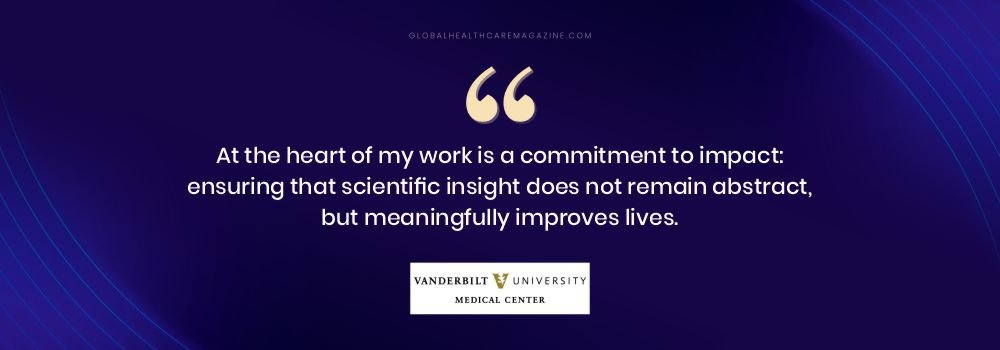
“This life we have is all about connecting the dots. Events are not random; they are strategically placed, and you are exactly where you need to be in the present time and place. You will not be able to make that connection until you have a place of solitude to reflect upon yourself and become wise.”
Great leaders, she believes, are great precisely because they protect time each day for contemplation and quiet thought, guarding it the way, as she puts it, “a mother protecting her baby.” It is not indulgence. It is a strategy. And when that time is taken away, she warns, the costs are real, compounding, and measurable: passion reduces, effort reduces, energy reduces, productivity reduces, and revenue reduces, significantly and exponentially.
It is a remarkable thing to hear a physician and AI engineer speak of solitude as a professional necessity. But then again, remarkable has always been the most accurate word for Dr. Gitanjali Srivastava.
She grew up in a family that counted scholarship pennies to pay for tomorrow. She cried when she could not save her first patient. She asked a question that her entire field did not want to answer. She helped unlock a $100 billion-plus market, walked away from her own program to build something far greater, and still finds time to build hovercrafts.
The dots, it turns out, were always going to connect.
Quotes
Also Read: The Most Influential Leaders in Obesity Medicine & Metabolic Health 2026