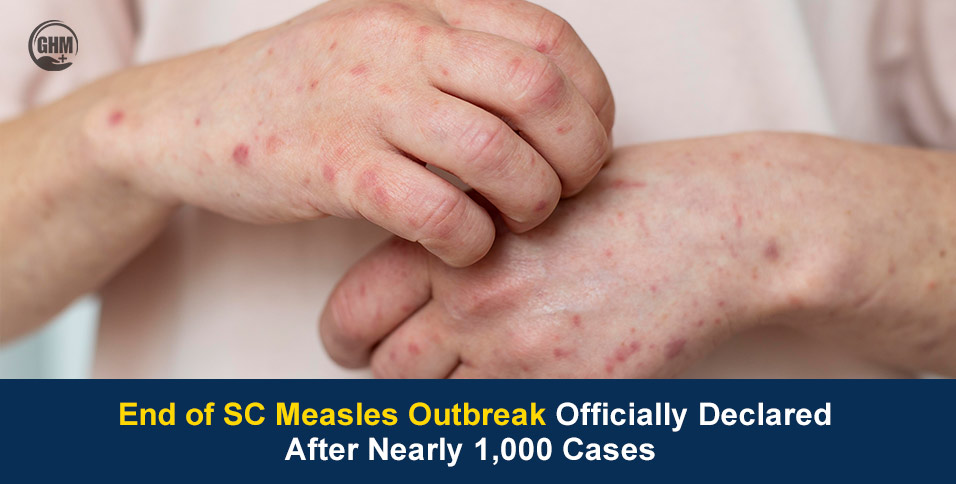
The end of SC measles outbreak has now been officially confirmed by state health authorities after 42 consecutive days without any new linked infections. The South Carolina Department of Public Health said the milestone marks the formal close of the largest measles surge seen in the United States in more than three decades.
The measles outbreak in South Carolina ended after months of public health efforts, school disruptions, emergency vaccination drives, and close monitoring of exposed residents. The outbreak began in October 2025 and eventually reached 997 confirmed cases, most of them in the Upstate region.
The Spartanburg measles outbreak was the main driver of the statewide emergency. Officials said the virus remained concentrated in one area of one county rather than spreading widely across South Carolina. This helped reduce broader statewide disruption, although schools and health systems across the Upstate still faced pressure.
According to state officials, even after the declaration of the end of SC measles outbreak is encouraging, but they also warned that future imported cases remain possible if vaccination rates fall.
How Was The End of SC Measles Outbreak Declared?
Health experts use a standard rule to determine when a measles outbreak is over. Two full incubation periods — or 42 days — must pass without a new case linked to the outbreak.
The last confirmed outbreak-related measles case in South Carolina was reported on March 15, 2026. Since no additional connected cases were found, officials announced the end of the measles outbreakon April 27.
In a public statement, interim agency director Dr. Edward Simmer thanked healthcare workers, schools, families, and public health teams who helped contain the spread.
He said, the response prevented “many more cases – and potentially more hospitalizations or even deaths.”
SC Measles Cases in 2026 Reached Historic Levels
By the time the measles outbreak ended, South Carolina had reported:
- 997 confirmed measles cases
- At least 21 hospitalizations
- More than 90% of cases in unvaccinated people
- Most infections in children and teens
The measles outbreak was one of the largest modern measles events in America and part of a wider rise in measles cases in the United States.
South Carolina Public Health Response In Crisis
The South Carolina public health response required months of intense work.
Officials said teams worked for nearly 30 straight weeks, including weekends and holidays.
Their efforts included:
- Case investigations
- Contact tracing (finding people exposed to infected patients)
- Quarantine guidance
- School coordination
- Vaccination outreach
- Data monitoring
Dr. Brannon Traxler, the state’s chief medical officer, said these actions helped place a “fire break ring” around the outbreak, slowing transmission.
Support also came from the CDC and Clemson University disease modeling experts.
Outbreak Increased Measles Vaccination in South Carolina
The measles outbreak led to a possible rise in demand for the MMR vaccine in South Carolina.
The MMR vaccine protects against measles, mumps, and rubella.
According to health officials:
- Spartanburg County vaccine doses nearly doubled year-over-year
- Statewide doses increased by about 31%
- Many vaccinations were given to children under the age four
Experts believe seeing local cases may have encouraged hesitant families to vaccinate.
This may be one positive long-term effect of the Upstate South Carolina measles outbreak.
Measles Outbreak Response Costs Reached Millions
The measles outbreak response costs were also high.
State officials estimated at least $2 million in direct public health spending. That includes staffing, emergency response operations, testing support, and vaccination efforts.
Schools also faced hidden costs. Hundreds of students had to stay home after exposure, leading to thousands of missed in-person school days.
Final Takeaway
The end of SC measles outbreak is a major milestone, but it does not mean measles risk has disappeared.
The CDC has reported continued outbreaks elsewhere in 2026. Imported cases from travel or spread from other states can still happen, especially where vaccination coverage is low.
Health leaders say the best protection remains routine childhood immunization and quick public health action when cases appear.