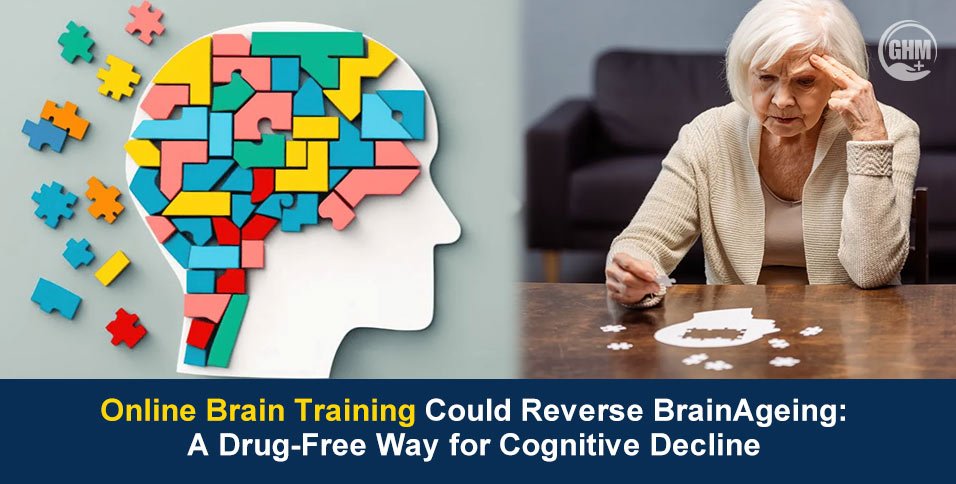
In a groundbreaking study from McGill University, scientists discovered that a digital online brain training program could reverse up to 10 years of decline in a key brain system linked to memory and learning.
The findings show that older adults who played brain training games for just 30 minutes a day over 10 weeks experienced measurable biological improvements. It is a result that no drug has achieved in this way.
This emerging trend has experts rethinking how we approach cognitive decline, dementia prevention, and neurological health in an ageing world.
What is the Breakthrough in Online Brain Training
The study tested a Brain Training app called BrainHQ, developed by Posit Science Corporation. Ninety-two healthy adults over age 65 were divided into two groups: one trained using adaptive mental exercises designed to challenge attention and speed, while the other played regular computer games.
After ten weeks, brain scans revealed something extraordinary. Those who used BrainHQ showed improved function in the cholinergic system, a part of the brain that supports focus and memory.
“We saw cholinergic activity at levels typically found in people ten years younger,” said Dr Thien Thanh Dang-Vu, senior author of the study. “It’s the first evidence that a non-drug intervention can restore this kind of neurochemical function.”
This means the online brain training didn’t just make participants feel mentally sharper, but it actually changed their brain chemistry in measurable ways.
Why This Matters: Drugs vs. Digital Brain Training
For decades, medical research has focused on Alzheimer’s and dementia medications, but their results have often been modest.
Drugs such as donepezil and memantine can temporarily boost neurotransmitters or slow symptom progression, but they don’t reverse brain ageing. Moreover, they often come with side effects like nausea, sleep disturbance, or fatigue.
In contrast, online brain training is:
- Non-invasive: no pills, no side effects.
- Accessible: available through mobile and web apps.
- Adaptive: adjusts difficulty based on individual performance.
- Affordable: compared to long-term drug treatments or therapies.
That said, researchers emphasise that brain training should complement, not replace, medical care.
But it opens a new conversation: can mental exercise serve as a digital medication for brain health?
What Is The Science Behind Reverse Ageing
The researchers stated it makes the brain “10 years younger”, but it doesn’t mean a full reversal of ageing. It refers specifically to cholinergic efficiency, the communication network that supports memory and learning.
Using advanced PET imaging, scientists could visualise how online brain training improved acetylcholine transporters in key brain regions. These transporters help maintain the brain’s “alert system,” which typically weakens with age.
This is the first time an intervention through digital healthcare apps has been shown to restore a chemical pathway related to cognitive performance, a milestone even pharmaceutical drugs haven’t achieved.
How are Online Games Different From Puzzles?
While crosswords and Sudoku are good for mental engagement, studies show they don’t necessarily build neuroplasticity, the brain’s ability to form new connections.
What sets online brain training apart is that it uses adaptive difficulty and multi-sensory engagement to strengthen attention networks and processing speed.
Apps like BrainHQ are structured to mimic real-world cognitive challenges such as driving, reacting quickly to new information, or recalling details under distraction.
“It’s not about memorising facts,” said Dr Henry Mahncke, CEO of Posit Science. “It’s about training the brain’s ability to adapt and respond, a skill that naturally declines with age.”
Global Relevance & Policy Impact Of Mind Training
Worldwide, over 55 million people live with dementia, and this number is expected to nearly double by 2050.
Healthcare systems are under pressure to find preventive, cost-effective ways to reduce the burden of cognitive decline.
Online brain training could become part of this solution for older adults with digital healthcare apps, a scalable tool that complements diet, exercise, and social engagement.
Governments and health organisations are beginning to explore the inclusion of mental fitness programs in healthy ageing strategies.
Early trials suggest that brain games for adults could help delay mild cognitive impairment, potentially lowering long-term care costs.
The Caution
While the results are promising, experts urge caution. The McGill trial was small and short-term, and it involved healthy seniors, not dementia patients.
Long-term benefits, real-world improvements, and durability of results remain to be seen.
Still, the online brain training movement has opened a new frontier in cognitive health, merging technology, neuroscience, and public health in ways once thought impossible.
As Dr Dang-Vu put it, “This may be the beginning of a shift in how we preserve brain health from treating decline to training resilience.”
Integrating mental fitness into everyday life may soon be as important as diet and exercise.