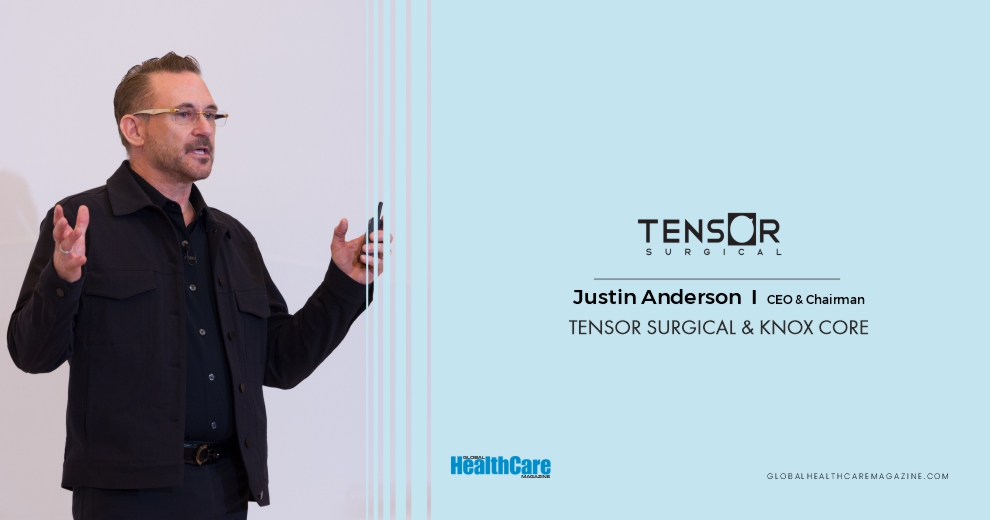
Modern medicine moves fast. New devices enter the market every year, each promising better outcomes, faster recovery, and lower costs. Yet inside operating rooms, progress does not come from marketing rhetoric. It comes from solutions that work exactly as surgeons expect them to work. It comes from systems designed with precision, tested against real anatomy, and built to last. This balance between innovation and practical application has defined Justin Anderson’s career over three decades. He serves as CEO, President, and Chairman of Tensor Surgical and Knox Core, and as co-Managing Member of Passer Stitch.
What first drew him into the medical device industry was not the shine of innovation alone. It was the measurable effect innovation could have on a human life. From the beginning of his career, he worked closely with some of the world’s most respected orthopedic sports medicine surgeons. They did more than collaborate with him; they mentored him. Inside operating rooms, he observed how small design decisions influenced surgical accuracy. By following post-surgical outcomes, he saw how thoughtful engineering could reduce recovery time, improve long-term durability, and extend the careers of professional athletes.
He began to recognize a pattern. Engineering theory often appears flawless on paper or in a 3D CAD model. Clinical reality is far less forgiving. “The distance between engineering theory and clinical reliability directly affects patient outcomes,” Justin says.
That realization shaped his direction. He committed himself to narrowing that gap — developing technologies grounded in biomechanical science, supported by clinical validation, and aligned with economic responsibility.
Justin does not believe healthcare needs more incremental upgrades. In his view, surgeons need dependable solutions that do not introduce new variables or unintended complications.
“Healthcare does not need marginally improved products that offer no meaningful benefit to stakeholders,” he explains. “It needs reliable solutions built from first principles that enable physicians to deliver equivalent or better outcomes, less pain, reduced opioid use, and significantly lower cost. That is the essence of value-based care in the post-COVID modern era of healthcare.”
His perspective did not form in a laboratory alone. Before entering business, Justin competed at the highest levels of sport. As a former professional athlete, two-time World Champion, and five-time National Champion, he experienced firsthand the advantages of advanced medical care. Injuries are common in elite competition, and access to cutting-edge technology helped extend his career. Many patients, he realized, never receive that level of treatment. That imbalance left a lasting impression.
Since then, Justin has built and scaled ventures at the intersection of orthopedics, sports medicine, biologics, and digital health. His contributions have led to two IPOs and six profitable exits, collectively generating over $4 billion in value. For Justin, however, the most meaningful metric is not financial. It is the number of patients whose outcomes improve when engineering theory and clinical practice align.
Rethinking Soft-Tissue Repair at Tensor Surgical
Over time, Justin observed a troubling pattern in orthopedic operating rooms. Despite billions invested in suture anchor technologies over three decades, healing rates have not significantly improved. Implant density and costs have increased without solving the biological problem.
“We learn a great deal about the durability of a repair and a device at the time of revision surgery,” Justin notes. “What becomes clear is that certain implants compromise bone much more than initially anticipated, which may complicate future procedures.”
Tensor Surgical was founded with a focused objective: to reduce dependency on implants that add cost without delivering proportional biological benefit. The company’s proprietary platform eliminates the need for suture anchors, helping preserve bone and significantly reduce economic burden.
“Our philosophy is simple,” Justin says. “Pro-biology, pro-mechanics, and pro-value.” For him, true surgical progress involves restoring anatomy while respecting the principles of healing physiology and economic sustainability. Innovation should improve outcomes, lower systemic cost, and reduce risk.
Engineering Precision in a Competitive Field
In a market crowded with new implants and bold claims, Justin believes differentiation begins with philosophy. For decades, much of orthopedic soft-tissue innovation has focused on stronger fixation at time zero, which often involves an increase in implant density and iterative hardware complexity. Tensor Surgical chose a different path. The company prioritizes load-sharing biomechanics and bone-preserving fixation over load-bearing anchor constructs and increased implant density.
Operational discipline further distinguishes the firm. Justin integrates AI-driven systems that increase speed and precision. He recently implemented an AI-enhanced image dimension instant measurement platform capable of analyzing up to 5,000 critical dimensions per part across 1,000 parts simultaneously in approximately one second.
“Performing 100% inspection on every dimension of every part enables us to hold suppliers accountable to sub-micron tolerances,” he says. “The best products are simple to use and boringly reliable.”
When engineering rigor meets disciplined execution, reproducibility improves — and markets respond.
Building Enduring Value in MedTech
Justin does not measure success solely by exits. He studies what allows the most sustainable companies to endure long after a marquee product launch. In his view, long-term value begins with meaningful innovation — not incremental iteration. Breakthroughs that are materially better create defensible intellectual property, resist commoditization, and reset standards of care.
Referencing Peter Thiel’s philosophy on challenging assumptions, he notes that building the future requires questioning entrenched dogma and re-examining accepted truths. That process demands intellectual courage. Sustainable companies, Justin believes, prioritize patient outcomes over profit. When innovation is grounded in evidence and economic alignment, it compounds.
Aligning Stakeholders Around Value
Justin builds companies the same way he builds products — starting with alignment. Tensor Surgical collaborates directly with orthopedic surgeons, integrated health systems, and manufacturing partners to ensure that innovation serves clinical durability and economic sustainability.
“The true value of a Rotator Cuff repair is not determined solely by how it performs when it succeeds,” Justin says, “but by what it preserves if revision becomes necessary.”
That perspective reframes value beyond immediate performance and toward long-term stewardship of biology.
Adaptive Leadership across Multiple Roles
Leading multiple organizations and serving on several boards requires adaptability. Justin views balance as fluid. Some moments require strategic altitude. Others demand immersion in technical detail. He adjusts based on what drives the fastest meaningful progress towards 10X improvement.
He studies leaders such as Elon Musk, Jensen Huang, and Peter Thiel, drawing lessons in first-principles reasoning, speed, and bold ambition. Yet he filters those lessons through his own operating style: creating proprietary advantages that are ten times better along a critical dimension rather than marginally improved across many.
That standard requires proximity to engineering and execution. He calls this “being useful.” To multiply impact, he teaches teams to break down problems from first principles so they can reason independently. For Justin, the correct level of involvement is simple — whatever accelerates outcomes that matter.
When Conviction Meets Resistance
Creating a new category rarely follows a straight path. Justin experienced this while creating the global market for modern anchorless arthroscopic transosseous Rotator Cuff repair when it didn’t exist, from a zero baseline. The field was long dominated by anchor-centric models. Reducing implant dependency required generating evidence, building clinical consensus, and persuading surgeons to reconsider established norms by challenging profit-driven industry dogma.
“I prioritize a successful patient outcome after one operation much higher than saving the surgeon a few minutes,” Anderson states. “Both are important, but people tend to forget who and what really matters the most,” he adds.
“There was no existing market,” he recalls. “We had to build the clinical argument from the ground up, one patient at a time.”
That process required resilience and disciplined conviction. “When you challenge prevailing narratives, clarity of mission becomes the stabilizing force,” Justin says. Transparency, scientific rigor, and long-term outcomes ultimately determine which innovations endure.
Measuring Impact by Enduring Adoption
When asked about impact, Justin points not first to valuations, but to operating rooms. Years after commercializing numerous technologies, surgeons worldwide continue to use his products as definitive treatment solutions.
“Impact is measured in durable clinical relevance,” he says.
Medical devices often arrive with excitement and fade quickly. Sustained adoption tells a different story. It signals trust, consistent performance, and outcomes that justify continued use. For Justin, that longevity carries more weight than headlines.
Sustaining Performance beyond the Office
Justin does not view work-life balance as a fixed equation. Instead, he evaluates whether he is at peace with the tradeoffs he makes.
“The real question is not whether I am balanced, but whether I am at peace with the tradeoffs,” he says.
Primary relationships come first. Physical health remains non-negotiable. Clear thinking and disciplined intensity guide his work. Outside the office, he cherishes spending time with his fiancée, Dr. Elham Taherian (double board certified in Rheumatology and Internal Medicine), their two dogs, daughter Asia, family, and close friends.
Sustained performance, he believes, comes from clarity about what matters — and protecting it.
Integration as the Next Frontier
If Justin were to describe his next chapter in one word, it would be integration. At Tensor Surgical, that means combining biomechanical innovation with AI-enhanced platforms, digital twins, and high-speed simulation. These tools compress development cycles, lower costs, and improve reproducibility at scale.
In partnership with engineer Scott Heneveld, Justin put together a consortium of world-renowned shoulder surgeons and the owners of a leading arthroscopic medical device manufacturing company to develop Shogun™ — the world’s first reusable multifunction suture passer with a limited reusable shape set nitinol needle. The device addresses the second-highest cost driver in arthroscopic Rotator Cuff repair (second only to the unsustainable cost of suture anchors, which Tensor’s proprietary TransOs Tunneler addresses) while emphasizing durability and design simplicity.
With multiple successful surgeries completed (including use on his own knee), 13 U.S. and international patents issued (with additional filings pending), national contracts in place with major U.S. healthcare systems, and purchase orders already received prior to commercial launch, the platform is gaining significant traction with surgeons and strategic interest from the largest orthopedic companies in the world.
Justin says, “Shogun™ is a pure exit play, so we will be entertaining offers from suitable large-cap orthopedic acquirers later this year.”
Beyond devices, Justin and genius coder Xiaoduo Wang co-founded Knox Core™ to develop a proprietary AI execution control layer designed to standardize how intelligence is routed, governed, and scaled. Knox OSTM, which they built natively using the blazing fast and memory efficient programming language Rust, provides unified routing across model providers, persistent memory, and deterministic execution. The first application layer is already live via Knox.chat and expanding into enterprise environments.
“The long-term opportunity in AI is not competing on models,” he says. “It is governing intelligence at scale.”
The Moral Weight of Innovation
As the conversation turns reflective, Justin returns to first principles. Healthcare carries responsibility beyond revenue or quarterly performance. Every device placed in a patient represents trust.
“Innovation in healthcare carries moral weight,” he says.
That weight demands discipline. A product must justify its existence through improved outcomes, preserved biology, and economic sustainability. If it cannot demonstrate those elements, it does not belong in the operating room.
Leadership, he argues, is not defined by market share alone. It is measured by whether the healthcare ecosystem becomes more accountable, more efficient, and more durable because you helped shape it. Outcomes first. Integrity always. Sustainability over spectacle.
Quote

Also Read: The 10 Most Impactful Medical Device Leaders to Watch in 2026