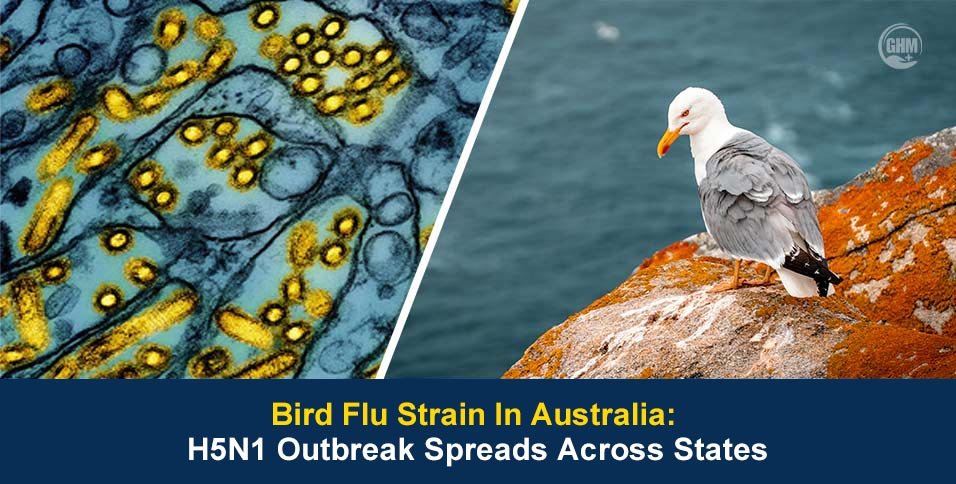
Recently, the first bird flu strain in Australia was detected, ending the nation’s virus-free status.
Now, Australia’s bird flu outbreak has escalated significantly, expanding across five states with tens of confirmed cases in wild seabirds. As of late July 2026, the nation’s tally of confirmed H5N1 cases has reached 33, alongside dozens of suspected detections, including a potentially critical case in a seagull on South Australia’s southeast coast.
The rapid transmission of this migratory bird virus in Australia has prompted agriculture and environment ministers to enact the H5 National Management Agreement after experts advised eradication is no longer technically feasible. While lab tests at the CSIRO bird flu testing facility continue, authorities are scrambling to protect native wildlife.
Suspected Bird Flu Strain In Australia Detected Across Multiple States
After the first detected case of bird flu strain in Australia in June, the landscape of the outbreak changed rapidly. South Australia has emerged as the current epicenter, logging 19 confirmed cases and 21 suspected cases of the highly pathogenic H5N1 strain. Recent surveillance identified suspected bird flu cases in Australia across WA, Victoria, New South Wales, and other jurisdictions totaling 14 confirmed cases outside SA.
A recent suspected case in a seagull at Robe, SA, has raised urgent alarms. “Gulls move between beaches, wetlands, farmland, and urban areas, which could carry the virus into a much wider range of wildlife, poultry, and environments,” warned Assoc. Prof. Suman Majumdar of the Burnet Institute.
Furthermore, Victoria’s Chief Veterinary Officer, Dr. Graeme Cooke, confirmed testing on multiple greater-crested terns along the state’s southwest coast. Samples continue to undergo rapid evaluation at the CSIRO’s Australian Centre for Disease Preparedness in Geelong.
Bird Flu Outbreak in Australia A Major Turning Point
For years, Australia has stood alone as the only continent free from the highly destructive, globally circulating H5 bird flu disease. The confirmation of the H5N1 bird flu strain in Australia marked the end of mainland Australia’s status as the final continent free from the virus.
While Australia previously detected the H5 strain on its remote external territories late last year, a mainland detection poses a much more immediate threat to localized ecosystems and domestic industries.
With local transmission now established among wild seabird populations, particularly greater crested terns, the focus has shifted from prevention to containment.
Government Response to Bird Flu Strain In Australia
In response to the bird flu outbreak in Australia spreading across five states, Agriculture Minister Julie Collins announced an immediate activation of national biosecurity protocols. The government officially enacted the H5 National Management Agreement following expert consensus that eradicating the virus in wild bird populations is not feasible.
The government response to Bird flu strain in Australia involves several key steps:
- Targeted Funding: Building on an initial $113 million preparedness pool, the federal government released an additional $24 million directly to states and territories in July.
- Surveillance and Carcass Removal: Expanding wildlife monitoring while implementing carcass removal programs to slow the spread among scavenging species.
- Public Reporting Systems: Public channels via birdflu.gov.au remain active for reporting sick or dead wildlife.
“We have vowed to do everything we can to help protect Australia’s wildlife, agricultural industries, and the national economy,” Minister Julie Collins stated.
Kangaroo Island Outbreaks Threaten Wildlife
The ecological crisis reached a critical point following detections on Kangaroo Island, off South Australia’s coast. Four cases in greater crested terns were confirmed on the island, with one located directly at Seal Bay, home to roughly 5% of the global population of the endangered Australian sea lion.
In recent research, the bird flu virus at Heard Island had killed an estimated 13,359 southern elephant seal pups out of the total population of 17,364, with mortality reaching 97% in some breeding areas. Genetic mapping suggested the virus traveled 1,800 kilometers from the French sub-Antarctic Crozet Islands, likely arriving around August 2025.
To reduce human-borne stress from bird flu strain in Australia, SA authorities temporarily suspended beach tours at Seal Bay.
What Australians Should Do If They Find Sick or Dead Birds?
The public plays a vital role in early virus detection. Biosecurity agencies have issued clear, actionable guidance for beachgoers, hikers, and residents:
- Do Not Touch: Never handle sick, injured, or dead wild birds or animals.
- Protect Pets: Keep dogs and other domestic pets well away from wildlife carcasses.
- Document from Afar: Take photographs or video recordings from a safe distance.
- Log the Location: Note the exact GPS coordinates or landmark descriptions.
- Report Immediately: Submit your findings directly to authorities via birdflu.gov.au or call the emergency animal disease hotline.
What Happens Next?
While commercial poultry systems and public health remain unaffected, the potential risk of the bird flu strain in Australia to native marine mammals and seabird colonies is deeply concerning given its global track record.
To tackle the spread and prepare for future growing flu outbreaks, countries like the USA and the UK have started bird flu vaccine trials.
State biosecurity teams will continue coordinating with CSIRO for ongoing testing as new suspected cases emerge. Authorities will focus on monitoring high-risk coastal zones, protecting poultry biosecurity perimeters, and implementing localized conservation strategies to safeguard vulnerable species.