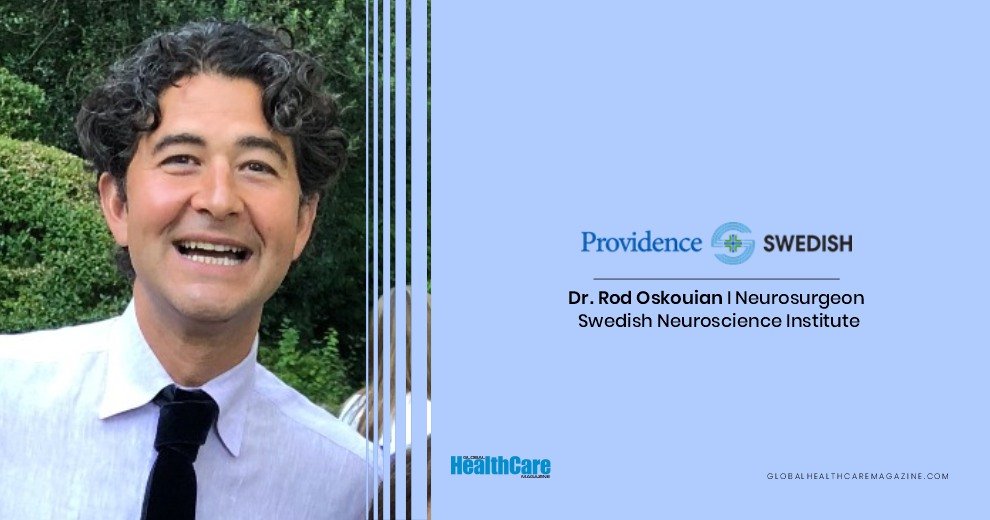
Somewhere in the records of Swedish Neuroscience Institute, there is a tally that most people would find difficult to comprehend: ten thousand surgeries, performed across two decades by a single pair of hands. The hands belong to the Chief of Spine, who has spent more than seventeen years since 2008 inside operating rooms in Seattle, working on spines twisted by deformity, invaded by tumor, shattered by trauma, or scarred by a previous surgeon’s best attempt. Dr. Rod Oskouian is still there, on-site, full-time, a fixture of a program he built almost from nothing into one of the most recognized spine centers in the Pacific Northwest.
Numbers alone do not explain a career. But in Dr. Oskouian’s case, they are impossible to ignore. Over five hundred peer-reviewed publications carry his name. More than seven thousand four hundred citations trail behind that body of work, the kind of academic footprint that turns a working surgeon into something closer to an institution. He has written seven surgical textbooks, published by leading medical publishers including Thieme, Elsevier, Springer, and Cambridge Scholars. These are not vanity projects. They are the books that other surgeons, in other operating rooms, reach for when a case gets complicated.
The Procedure That Was Called Impossible
Every surgeon has a signature. For Dr. Oskouian, it is the lateral lumbar corpectomy, a technique he pioneered in the United States, approaching the spine from the side rather than the front or back, sparing tissue and reducing risk in cases that once demanded far more invasive routes. “What was once called impossible is now the standard of care across the globe,” he says, and the sentence does not read like boasting so much as an accounting of fact. A technique that began as one surgeon’s innovation in Seattle now shapes how spine surgery is taught and practiced internationally.
Swedish recognized early what it had in him. Among the earliest adopters of robotic-assisted spine surgery in the region, he brought in Medtronic’s AiBLE platform and Stryker navigation systems well before they became common vocabulary in spine departments elsewhere. He is not a surgeon chasing technology for its own sake. He is a surgeon who has watched enough failures to know which tools actually change outcomes.
Building the Next Generation
There is a particular kind of generosity in choosing to teach, especially when your own hands are this busy. As Fellowship Director at Swedish, Dr. Oskouian has trained more than one hundred and thirty neurosurgeons, a number that, multiplied across their own careers and their own patients, dwarfs even his own surgical count. He also serves as an oral board examiner for the American Board of Neurological Surgeons, a role reserved for surgeons whose judgment other surgeons trust when certifying future neurosurgeons.
That instinct to teach reached further than Seattle. Since 2014, he has mentored surgeons at Kenyatta National Hospital in Nairobi, carrying expertise built in one of America’s best-resourced hospitals to a setting with far fewer resources and far higher stakes. It is the kind of commitment that rarely makes headlines but quietly reshapes what is possible for patients an ocean away.
In 2008, the same year he became Chief of Spine, Dr. Oskouian also co-founded the Seattle Science Foundation, where he served as President and CEO until August 2024, a run of sixteen years and eight months. “I co-founded the Seattle Science Foundation, a nonprofit delivering free, world-class surgical education to clinicians worldwide,” he says. The foundation was created to make high-quality surgical education freely accessible to clinicians around the world, regardless of institutional resources. Its work on spinal cord injury research was documented in a project titled Spinal Cord Injury Research Kickoff, shared publicly on Vimeo, a small window into a much larger body of work happening away from cameras. All of it reflects the same instinct that runs through his entire career: the belief that knowledge locked inside one operating room helps far fewer people than knowledge set loose into the world.
A Life Beyond the OR
What is striking about Dr. Oskouian’s résumé is how little of it fits neatly inside the walls of a hospital. He has served as an expert witness in hundreds of cases across state, federal, and local courts, working with both plaintiff and defense teams, a role that demands the same precision under scrutiny that surgery demands under a microscope. He has ventured into surgical robotics, spine implants, and physician education platforms, treating the business of medicine with the same seriousness he brings to the operating table. He also advises premedical students navigating the long road into medicine, a road he knows intimately.
And then there is AXON, the book in which he distills what ten thousand surgeries have taught him, not just about spines, but about brain health, sleep, and recovery. It is an unusual pivot for a surgeon known for technical innovation, but perhaps not surprising for someone who has spent two decades watching the body’s long arc toward healing, or its failure to heal, from the closest possible vantage point.
The Ongoing Work
Even now, Dr. Oskouian’s research has not slowed into a victory lap. The 3D Spinal Cord Atlas Project remains ongoing, a continuation of the same instinct that produced the lateral lumbar corpectomy years ago: look closer, map more precisely, and refuse to accept that the current technique is the final one. For a surgeon whose career has already reshaped a corner of neurosurgery, that restlessness may be the most telling detail of all.
Dr. Rod Oskouian’s story is not simply about volume, although the volume is staggering. It is about a surgeon who kept asking what came next – in the operating room, in the classroom, in Nairobi, and on the page – and who built institutions sturdy enough to keep asking that question long after he leaves the room.