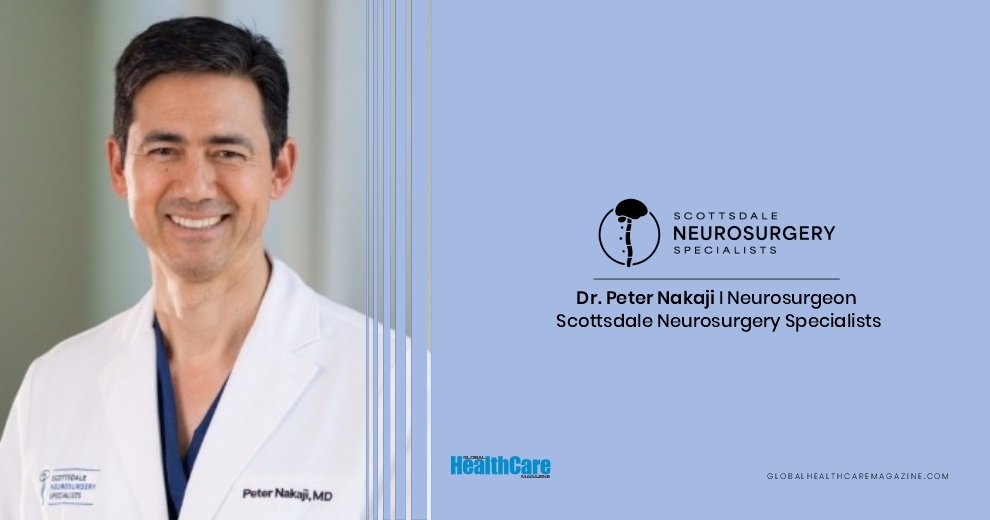
Most neurosurgeons spend their careers inside institutions built by someone else. This particular surgeon spent more than two decades building his credibility inside those institutions, and then, in February 2025, after more than two decades in practice, he did something rarer: he designed a new kind of practice from scratch. Dr. Peter Nakaji calls it “privademic,” a private practice built on an academic backbone, based in Scottsdale, Arizona, and named, simply and directly, Scottsdale Neurosurgery Specialists.
“Delighted to be launching a new private practice based in Scottsdale from where I will continue on my mission to provide superior cranial neurosurgery for patients in need, while driving innovation in education, research, and technology to keep the field of neurosurgery advancing,” Dr. Nakaji wrote at the time. It reads less like a press release and more like a mission statement he had been drafting in his head for years.
The Keyhole Philosopher
Dr. Nakaji’s specialty is the brain itself: tumors, cerebrovascular disorders, trigeminal neuralgia, hemifacial spasm, and Chiari malformation, among other conditions that most people hope never to learn the names of. What distinguishes his approach is scale, or rather, the deliberate shrinking of it. He is a pioneer in neuroendoscopy, the “keyhole” treatment of conditions like trigeminal neuralgia and colloid cysts, working through incisions smaller and less traumatic than the field once considered possible. His vascular practice covers aneurysms, arteriovenous malformations, cavernous malformations, and carotid artery disease, while his broader neurosurgical practice also includes brain tumors, skull base surgery, and selected spinal conditions.
“He is a strong proponent of the ‘minimally invasive’ surgical philosophy,” his own biography states, describing surgery designed to produce the least possible discomfort and disfigurement, with faster recovery built into the plan from the first incision. It is a philosophy, not just a technique, and he applies it as much to how he runs a room as to how he holds a scalpel. His practice style is collaborative by design: patients, families, and medical staff are treated as members of one team, a structure he credits with producing better outcomes and greater satisfaction.
The Education That Built the Surgeon
Dr. Nakaji’s training reads like a map of where minimally invasive neurosurgery was refined. He completed his residency at the University of California, San Diego, in the Division of Neurological Surgery, then traveled to Sydney, Australia, for fellowship training in endoscopic neurosurgery at the Centre for Minimally Invasive Neurosurgery under the direction of Dr. Charles Teo. From there, he completed a second fellowship, this time in cerebrovascular and skull base surgery, at the Barrow Neurological Institute under the direction of Dr. Robert Spetzler, one of the most influential names in American neurosurgery. He then joined Barrow’s staff as an attending neurosurgeon, a relationship with the institution that would stretch on for decades.
Two Decades at the Center of Phoenix Medicine
From 2003 to 2019, Dr. Nakaji served as a neurosurgeon at St. Joseph’s Hospital and Medical Center, a run of sixteen years, while working as an associate and later partner at Barrow Neurosurgical Associates from 2004 to July 2019. In July 2019, his role expanded considerably. He became Chair of the Department of Neurosurgery, a post he held until January 2025, and Director of the Neuroscience Institute at Banner Health, serving from August 2019 to February 2025.
“I am honored to have recently joined the University of Arizona College of Medicine–Phoenix to become Chair of Neurosurgery and serve the campus as Director of the Neuroscience Institute,” he said of the appointment. “I am joining an excellent community of dedicated professionals encompassing many specialties.” In these leadership roles, he oversaw the strategic growth and integration of neuroscience services across Banner Health’s network while continuing an active clinical and academic practice.
He remains Professor of Neurosurgery at the University of Arizona College of Medicine–Phoenix, a post he has held since August 2019, and continues to serve as Neurosurgery Residency Program Director at Banner University Medical Center Phoenix, shaping the next generation of surgeons even as he steps back from full-time academic administration.
Throughout these leadership transitions, his clinical identity remained constant: a board-certified neurosurgeon dedicated to advancing cranial neurosurgery through patient care, innovation, and education. “Dr. Nakaji is board certified by the American Board of Neurological Surgeons,” his biography states, and that certification, earned decades ago, is the credential every subsequent title has built upon.
An Inventor’s Instincts
Beyond the operating room and the lecture hall, Dr. Nakaji has built a career layered with entrepreneurship. He describes his own experience as spanning private and privademic practice, hospital co-management, clinic administration, strategy, operations, and academic practice, along with intellectual property, invention, patents, start-up founding, and fundraising in the medical space. He is a co-founder of GT Medical Technologies, one concrete example of turning surgical insight into a company. “He is active in biomedical research in neurosurgery, a strong advocate for medical and neurosurgical education, a successful inventor, and participates in many aspects of organized neurosurgery,” his biography notes, a summary that reads almost as an understatement given the breadth beneath it.
What Comes Next
At Scottsdale Neurosurgery Specialists, Dr. Nakaji says the focus is on highly specialized, leading-edge, destination care for selected neurosurgical problems, paired with what he calls the best possible patient experience. It is a smaller stage than the one he built at Banner Health, deliberately so. After more than two decades spent expanding programs, training residents, and steering system-wide strategy, Dr. Nakaji has chosen, at this stage in his career, to narrow his focus back down to the thing that first drew him into neurosurgery: the patient, the problem, and the smallest possible incision required to solve it.