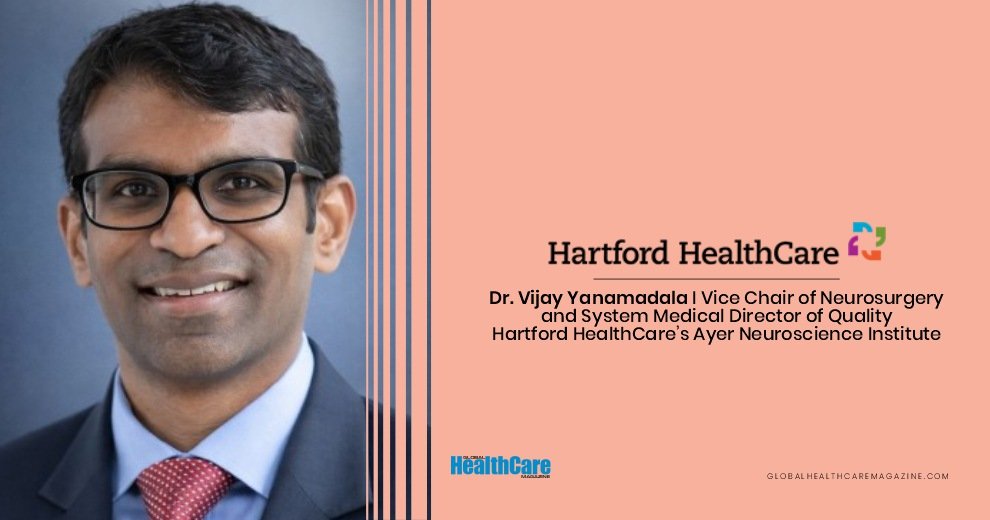
Harvard does not often hand out four degrees to the same person in the space of five years. One surgeon collected four there in a remarkably short span: a B.A. in Biochemical Sciences, earned magna cum laude in 2007, an M.A. in Chemistry the same year, an M.D. from Harvard Medical School in 2012 through the prestigious Harvard-MIT Division of Health Sciences and Technology, and an M.B.A. from Harvard Business School, also completed in 2012. Dr. Vijay Yanamadala, in between all of it, was named a Paul and Daisy Soros Fellow for New Americans in 2008, a recognition reserved for immigrants and children of immigrants building unusually ambitious careers. The degrees, stacked together, suggest a person who could not decide between medicine and business. In practice, they suggest someone who understood, earlier than most surgeons do, that the two would eventually need to speak to each other.
Today, Dr. Yanamadala serves as Vice Chair of Neurosurgery and System Medical Director of Quality at Hartford HealthCare’s Ayer Neuroscience Institute, a title he assumed in March 2026. But the title undersells the tenure. He has been with Hartford HealthCare for more than five years, and the layers of his role there have accumulated steadily: Board Certified Neurosurgeon since March of 2021, System Medical Director of Spine Quality and Surgical Optimization since that same month, and System Medical Director of Neurosurgery Quality, Research and Innovation since March of 2024.
The Awake Fusion
Dr. Yanamadala specializes in complex spine surgery, and within Connecticut, he holds a specific distinction: he pioneered awake spinal fusion surgery in the state, a technique that allows patients to remain conscious during a procedure traditionally performed under general anesthesia. It is the kind of innovation that rarely makes front-page news but quietly changes recovery times and complication rates for the patients who undergo it. His academic output backs up the clinical reputation. He has published more than ninety-five peer-reviewed papers in leading neurosurgical and medical journals, covering surgical outcomes, quality improvement, artificial intelligence in healthcare, and digital therapeutics, a research portfolio that reads like a bridge between two eras of medicine.
The recognition has followed. He has been named a Top 10 Power Player in Spine Surgery, selected for the North American Spine Society’s 20 Under 40 list of physicians, and featured as a Crain’s New York Business Notable Leader in Health Care in 2023.
Four Years Running an AI Company From the Inside
In February 2022, Dr. Yanamadala took on a role unusual for a practicing neurosurgeon: Chief Medical Officer of Sword Health, an AI-powered digital healthcare company delivering clinically validated AI physical therapy, musculoskeletal care, women’s health, and mental health support to millions of patients globally. He held the position until February 2026. Under his clinical leadership, Sword published more than forty peer-reviewed studies demonstrating that AI-powered digital care could achieve stronger clinical outcomes than conventional physical therapy, work that helped set a new benchmark for what digital healthcare quality is supposed to look like.
It was not a detour from surgery so much as an extension of it. As an early adopter of healthcare AI, he implemented AI documentation tools in his own clinic at Hartford HealthCare, giving him hands-on experience translating AI capability into the messy reality of clinical workflow, not just its theoretical promise. That combination, surgical authority paired with years spent inside one of the field’s most prominent AI health companies, sets him apart from executives who understand AI only from a boardroom or surgeons who understand it only as a rumor down the hall.
Building Quality Into the System, Not Just the Room
Before Hartford HealthCare, Dr. Yanamadala spent two years and two months, from February 2019 to March 2021, as a neurosurgeon and Director of the Center for Surgical Optimization at Montefiore Health System, alongside an appointment as Assistant Professor of Neurosurgery at Albert Einstein College of Medicine over the same period.
“As the Director of the Center for Surgical Optimization, I have worked to improve patient outcomes systemwide through the application of multidisciplinary care pathways and hospital-wide and system-wide standardization of preoperative, intraoperative and postoperative pathways,” he later reflected. “We have also enacted numerous cost-saving initiatives through the streamlining and standardization of operating room supplies and workflows.”
It is a description that reveals how early his instinct toward systems thinking, not just individual surgical skill, took hold.
He also holds academic rank at Quinnipiac University’s Frank H. Netter School of Medicine, first as Assistant Professor of Surgery in Neurosurgery beginning in March 2021, and then as Associate Professor beginning in November 2021, a post he still holds. Alongside his clinical and academic work, he serves on the Medical Advisory Board of Cohere Health, a role he has held since June 2020, and has been a member of Slice of Healthcare since July 2023.
Where the Training Happened
Dr. Yanamadala’s surgical foundation was built at Massachusetts General Hospital, where he completed a neurosurgery residency spanning six years and nine months, from June 2012 to February 2019. Along the way, he completed a fellowship in orthopaedic spine surgery at MGH’s Department of Orthopaedic Surgery, from August 2015 to January 2016, followed by a fellowship in complex spine surgery and spinal deformity at Virginia Mason Medical Center, from February 2016 to February 2017. Even earlier, before medical school had fully claimed him, he spent five months in early 2012 as a Healthcare Field Study Intern at Bessemer Venture Partners in Cambridge, Massachusetts, assessing the clinical neuroscience start-up landscape across healthcare IT, services, pharmaceuticals, and medical devices. It was, in hindsight, an early rehearsal for the dual fluency in medicine and business that would come to define his career.