Every year, millions of fitness enthusiasts and bodybuilders hit a wall in the gym. They train hard in the gym, track protein intake, and get adequate rest, yet progress often hits a plateau. When progress slows down, many people look for a proven edge to spark new progress. While anabolic steroids once dominated fitness discussions, many athletes can now explore peptides for muscle growth as a potential alternative to direct hormone injections.
Explore this guide to learn how muscle growth peptides communicate with your body and how they differ from synthetic hormones. Also, get to know the different peptides for muscle growth with their benefits and the risk factors before considering them in your fitness journey.
What Are Peptides and How Do They Work?
Peptides are short chains of amino acids, which serve as the fundamental building blocks of proteins. While a typical protein contains hundreds or thousands of amino acids linked together in complex shapes, a peptide consists of a much shorter string.
In the human body, natural peptides act as precision signaling molecules. They attach to specific cellular receptors and send clear instructions to organs, telling them when to release hormones, repair damaged tissue, or adjust metabolic functions.
Synthetic peptides mimic these natural signaling sequences. Unlike anabolic steroids, which introduce large amounts of artificial hormones into the bloodstream, growth hormone peptides simply signal your pituitary gland to release more of its own natural human growth hormone (HGH).
When your pituitary gland releases growth hormone, it triggers your liver to produce Insulin-like Growth Factor-1 (IGF-1). This downstream hormone activates cellular pathways like mTOR, which directly stimulate muscle protein synthesis and cell repair.
Scientists categorize these compounds into distinct types of peptides based on their mechanism:
- Growth Hormone Releasing Hormones (GHRH): Compounds that tell the pituitary gland to release baseline growth hormone over an extended period.
- Growth Hormone Releasing Peptides (GHRP): Compounds that create a quick, clean pulse of growth hormone release.
- Direct Repair Peptides: Compounds that target tissue regeneration directly rather than driving systemic hormone levels.
How Do Peptides For Muscle Growth Work?
Understanding how muscle-building peptides influence the body requires a closer look at three main biological pathways: hormone stimulation, cellular protein synthesis, and systemic tissue repair.
- Growth Hormone Release
Instead of flooding the bloodstream with synthetic hormones, growth hormone secretagogues encourage natural, pulsatile hormone release. The body naturally secretes human growth hormone in rhythmic pulses throughout the day and night. Peptides work in harmony with this natural pattern, preserving the body’s feedback loops and avoiding the complete shutdown of endogenous hormone production.
- Increased IGF-1 Production
Once growth hormone enters the bloodstream, it travels to the liver. The liver responds by manufacturing IGF-1, the key biological driver of skeletal muscle growth. Higher IGF-1 levels enhance amino acid absorption inside muscle cells, increase protein synthesis, and inhibit muscle breakdown. This anabolic cascade helps create an optimal biological environment for adding lean body mass when paired with progressive resistance training.
- Recovery Support
Tissue repair forms the cornerstone of effective strength training. Certain peptides for muscle recovery assist cellular regeneration and support tendon and ligament health. Furthermore, because growth hormone release peaks during deep sleep cycles, secretagogues often support sleep quality, which further accelerates physical recovery.
While preclinical trials show promising biological mechanisms, clinical trials proving that these compounds significantly increase muscle size in healthy, trained adults remain limited.
The Best Peptides for Muscle Growth
Researchers and clinical specialists evaluate several key compounds when studying peptides for bodybuilding and recovery.
Here is how the most popular options in muscle growth peptides compare:
- CJC-1295: An analog of growth hormone-releasing hormones designed to provide sustained growth hormone release. CJC-1295 keeps baseline growth hormone elevated over longer windows. CJC-1295 remains an unapproved research compound for lean mass development.
- Ipamorelin: A selective growth hormone-releasing peptide that stimulates a clean pulse of human growth hormone without triggering significant spikes in cortisol or prolactin. Ipamorelin is currently an experimental compound not approved by the FDA for bodybuilding.
- Sermorelin: A shorter-acting analog of growth hormone-releasing hormones with a long history of clinical use. Doctors prescribe it for specific growth hormone deficiencies, making Sermorelin an established starting option in medical hormone optimization.
- IGF-1 LR3: A synthetic analog of IGF-1 with an extended half-life that directly drives muscle protein synthesis. IGF-1 LR3 remains restricted to laboratory study due to potential metabolic risks.
- BPC-157: A peptide fragment isolated from gastric juices, widely studied for tendon, gut, and ligament healing. Most evidence for the BPC-157 peptide component comes from animal studies, and it lacks FDA approval for human use. Most of the BPC-157 research cited in fitness circles used tightly controlled, independently tested compounds — a far cry from what’s typically sold as a supplement. Understanding what the BPC-157 data actually says is a useful starting point before drawing conclusions from gym forums.
- TB-500: A synthetic fragment of Thymosin Beta-4 that promotes cell migration and soft tissue repair. TB-500 remains an experimental research compound with limited human trials.
- Tesamorelin: A potent growth hormone-releasing hormone analog that reduces visceral gut fat and boosts IGF-1. Tesamorelin holds official FDA approval specifically for HIV-associated lipodystrophy, but not for general bodybuilding.
CJC-1295 and Ipamorelin Stack For Muscle Performance
In performance research, the combination of CJC-1295 and Ipamorelin represents the most studied peptide stack for muscle growth. These two compounds pull different cellular levers to create a synergistic effect.
CJC-1295 acts as the growth hormone-releasing hormone signal, widening the time window during which your pituitary gland can release growth hormone. Meanwhile, Ipamorelin acts as the growth hormone-releasing peptide signal, amplifying the height and strength of the actual growth hormone pulse. Together, CJC-1295 and Ipamorelin produce a significantly larger, cleaner release of natural human growth hormone than either compound can accomplish alone.
Researchers typically align this combination of CJC-1295 and Ipamorelin with the body’s natural circadian rhythm by evaluating nighttime administration. However, despite its widespread popularity in online forums, health enthusiasts must remember that human trials of CJC-1295 and Ipamorelin that verify long-term bodybuilding safety remain sparse.
Potential Benefits of Peptides for Muscle Growth
When evaluated in clinical settings under strict medical supervision, peptides for muscle growth offer several potential physiological advantages:
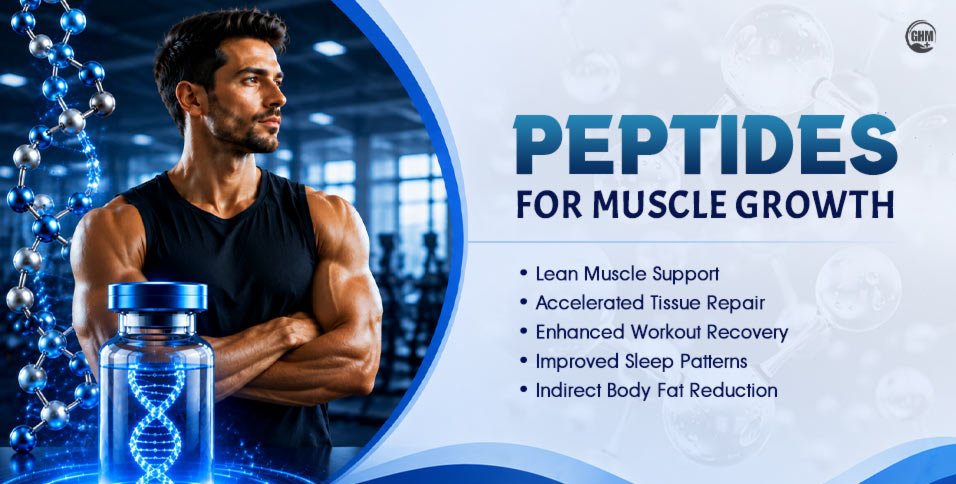
- Lean Muscle Support: Elevating natural IGF-1 drives amino acid delivery into skeletal muscle cells.
- Accelerated Tissue Repair: Certain healing peptides speed up recovery in strained tendons and connective tissues after heavy lifting sessions.
- Enhanced Workout Recovery: Shorter recovery intervals allow athletes to maintain training consistency and intensity over time.
- Improved Sleep Patterns: Boosting overnight growth hormone pulses often promotes deeper REM and slow-wave sleep cycles.
- Indirect Body Fat Reduction: Growth hormone promotes lipolysis, helping the body mobilize stored fatty acids for energy while maintaining lean tissue.
Risks, Side Effects of Peptides for Muscle Growth
Despite the potential benefits, using muscle peptides without medical oversight carries real health risks. Because many of these products circulate as unregulated “research chemicals,” quality control remains a primary concern.
Commonly reported side effects of Peptides include:
- Fluid retention and joint tightness
- Increased appetite and sudden hunger pangs
- Injection site redness, irritation, or local swelling
- Headaches, lethargy, or temporary flushing
- Decreased insulin sensitivity, which can elevate blood glucose levels over time
Severe health risks often stem from unverified online vendors. Independent laboratory tests reveal that unregulated peptide products often suffer from inaccurate dosages, heavy metal contamination, or complete mislabeling. Furthermore, using non-sterile injection protocols increases the risk of localized infections or bacterial abscesses.
Are Peptides Legal and FDA Approved?
Navigating the legal landscape of peptide therapy requires careful attention. There are only a small number of specific FDA-approved peptides for distinct medical conditions, such as Sermorelin for growth hormone deficiency or Tesamorelin for lipodystrophy. The FDA has not approved any growth hormone secretagogue for off-label bodybuilding or muscle enhancement in healthy individuals.
From an athletic compliance standpoint, the World Anti-Doping Agency (WADA) explicitly places all growth hormone secretagogues, growth hormone-releasing hormone analogs, and related repair compounds on its prohibited substances list. Tested competitive athletes who use these substances face severe anti-doping violations and suspensions.
Peptides vs. Anabolic Steroids: What is the Difference?
Many fitness enthusiasts compare peptides to steroids, but these two compound classes operate through completely different biological mechanisms.
- Biological Mechanism
Anabolic steroids are synthetic derivatives of testosterone. They directly enter muscle cells, bind to androgen receptors, and artificially force protein synthesis. Peptides do not bind to androgen receptors; instead, they act as upstream signals that encourage your own endocrine glands to release endogenous growth hormone.
- Impact on Natural Hormone Production
Steroid use completely suppresses the body’s natural testosterone production, often requiring complex Post-Cycle Therapy (PCT) to restart the endocrine system. Growth hormone peptides work within the body’s existing feedback loops, stimulating natural pulsatile release without shutting down the testicles or primary hormone pathways.
- Side Effect Profiles
Anabolic steroids frequently cause severe androgenic side effects, such as cardiovascular strain, liver toxicity, hair loss, and severe acne. Growth hormone peptides avoid androgenic side effects entirely, though they can still cause water retention, elevated blood sugar, and joint discomfort if misused.
Who Should Avoid Peptides?
Safety must always come first when evaluating hormone-modulating substances such as peptides for muscle growth. You should completely avoid peptide therapy if you fall into any of the following categories:
- Pregnant or Breastfeeding Women: Unknown developmental risks to the fetus or infant.
- Individuals with Active Cancer or Tumors: Elevated GH and IGF-1 levels promote cellular growth, which can potentially accelerate tumor progression.
- People with Uncontrolled Diabetes: Peptides can reduce insulin sensitivity and make blood sugar management difficult.
- Tested Competitive Athletes: Using prohibited secretagogues violates anti-doping codes.
- Anyone Shopping Without Medical Guidance: Buying unregulated powders from unverified online storefronts poses significant health hazards.
Summary
Peptides represent a fascinating area of medical science and biological signaling. By encouraging your body to release its own growth hormone, secretagogues like CJC-1295, Ipamorelin, and Sermorelin offer a controlled approach to supporting cellular recovery and metabolic health.
However, peptides for muscle growth are not a magic shortcut or a replacement for hard work. Sustainable muscle growth still depends on three foundational pillars: progressive resistance training, adequate protein intake, and sufficient sleep. If you choose to explore peptide therapy, always consult a licensed healthcare professional to conduct comprehensive bloodwork and guide your protocol safely.
Frequently Asked Questions
- Do muscle-building peptides cause hair loss?
No. Unlike anabolic steroids, peptides do not convert into Dihydrotestosterone (DHT), which is the hormone responsible for male pattern baldness. They do not interact with androgen receptors in your scalp follicles.
- Will peptides show up on a standard workplace drug test?
Standard 5-panel or 10-panel employment drug screens check for illicit narcotics, amphetamines, and prescription sedatives. They do not screen for growth hormone peptides. However, specialized anti-doping panels used in professional sports will detect them easily.