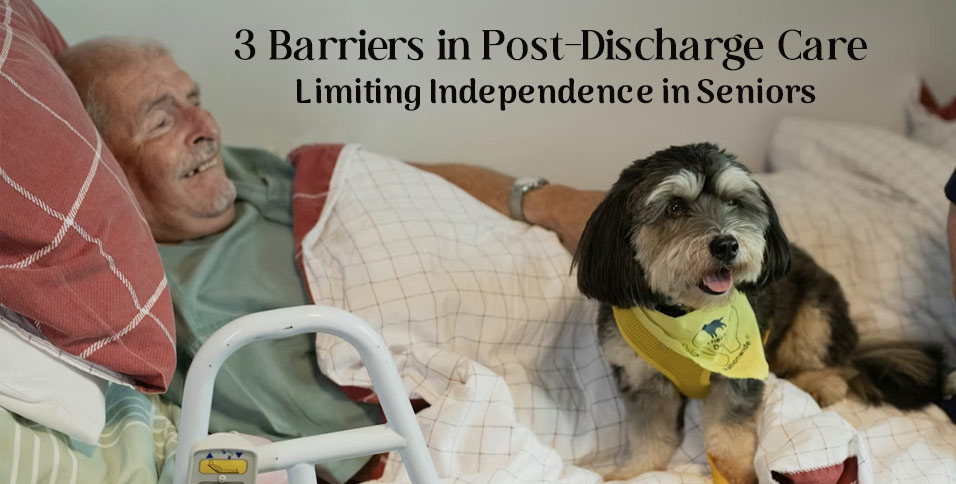
There is great joy for all parties involved when an older adult can return home from the hospital. Does that mean discharge is a finish line for healthcare teams?
It is often treated as one, although this stage is the shaky starting point for many seniors. For many, the real test has only begun as they must manage themselves at home.
Sadly, post-discharge care still lags, especially when it comes to the daily realities of a senior patient’s life. This article will break down three barriers to post-discharge care. You will also know how addressing these barriers can reduce complications and support independent living for seniors.
Weak Planning Before Discharge
What’s the right way to determine whether a patient is ready to manage things by themselves at home? Medical stability alone cannot give the right answer, especially when it comes to senior patients.
The reason why this often happens is that healthcare teams focus on test results and immediate markers of recovery. What needs to be assessed is whether the patient is truly ready for life outside the hospital.
Since factors are considered on a whim, there occurs an early breakdown in the planning process. For instance, in some cases, the need for basic tools for support is not taken into account. Otherwise, independent living aids for seniors could be introduced at this stage to prepare patients for safe movement and self-care.
Other than that, the following issues are also common:
- A lack of coordination between hospitals and home care services
- No clear direction as to who will look after the patient post-discharge
- Insufficient time spent on patient education before they leave for home
- Poor communication with family members or caregivers
- Absence of an organized discharge checklist that covers needs for home support
The Solution
To move past this barrier, healthcare teams cannot afford to treat discharge planning with a medical clearance mindset. Proper assessments are needed to ensure the senior patient is truly ready for discharge.
Seek multidisciplinary support even for the approval stage. Invest properly in patient education, which should include their family members. As stated earlier, consider additional living support for patients with functional limitations.
A Clear Disconnect Between Medical Advice And a Patient’s Daily Reality
Can discharge instructions become too complicated, even unrealistic, for patients to apply at home? Absolutely, and this is another major barrier.
In many cases, the advice is clinically sound, which it should be. However, it’s difficult for older adults to incorporate into their daily routine. A lot of it has to do with the limitations that naturally come with age.
Just think of an individual over 65 who must manage their medication, dietary changes, mobility requirements, and whatnot. If there is no consideration for their physical limitations or support system, then even the best care plan won’t help much.
Moreover, research has shown that the post-discharge period is often a high-risk phase. Unfortunately, this period is rife with poorly coordinated care, especially for older adults with multiple conditions.
Most patients are given detailed instructions, but with the assumption of proper stability and support at home. This reduces adherence among patients and often leads to complications that could have been avoided. So, what are some of the major gaps that need to be addressed?
- Complicated medication schedules that are difficult to track
- Exercise plans that do not match a senior’s strength or home conditions
- Nutrition-related advice that requires support with preparation
- Limited caregiver training, which affects the consistency of care
The Solution
Giving instructions, although easy, is not the answer. The advice itself must be practical, aligning with reality rather than ideal conditions.
Simplify the care instructions based on patient capacity, something which must be assessed before discharge.
Involve caregivers early in the process and use practical demonstrations. Ensure someone from the team keeps tabs by checking in periodically with the patient or their family.
Safety Risks in Home Setting
It’s important for healthcare providers to remember that many seniors do not have the luxury of returning to homes designed for recovery. Familiar spaces, especially one’s home, are desirable for their sense of familiarity and comfort.
However, things are different after discharge. Most older adults, already frail with age, may experience weakness and balance issues. That in itself can make even familiar spaces feel challenging and unsafe to navigate.
This is of immense importance in light of the fact that falls are a major health risk for seniors. As per the Centers for Disease Control and Prevention (CDC), at least one in four adults aged 65 and above experiences a fall each year. What’s more is that falls continue to be the number-one cause of injury-related death in this age group.
Now, most of these incidents are linked to everyday home conditions that are not modified after discharge. The following are the most common safety risks at home:
- Poor lighting that hides obstacles and may cause one’s steps to falter
- Slippery floors and loose rugs that increase the risk of slipping
- A dearth of proper handrails or support in bathrooms and stair areas
- Cluttered walkways that restrict safe movement
- Poor furniture placement that makes it difficult to move about easily
These risks cannot be considered trivial. They can directly affect an older adult’s mobility and speed of recovery.
The Solution
The role healthcare providers can play in removing this barrier has to do with treating the senior’s home as a part of the care setting, not separate from it. So, you can introduce basic home safety screening before discharge.
If necessary, recommend specific home modifications, like installation of handrails or grab bars. Engage family members and caregivers early for their help in implementation. Keep track of high-risk patients through EHR-supported follow-up visits and calls.
These barriers are not new, but what’s tragic is that they still exist despite the advancement in healthcare services. One of the main reasons for that is how the industry still operates on short episodes of treatment rather than a full continuum of recovery.
A 2024 study on post-acute transitional care interventions discovered something interesting. It was found that coordinated follow-up programs can reduce hospital readmissions by up to 33% in high-risk patients.
That’s a massive difference that continuity of care is capable of when built into the recovery process. To make it happen, care needs to extend beyond discharge. So, the future of healthcare will not focus just on sending patients home safely. It will ensure that patients can stay well and safe once they are in their homes.