What happens when a sudden accident, stroke, or medical event alters your life or the life of someone you love in a single fraction of a second? A traumatic brain injury is one of them. Facing a brain injury can feel like stepping into a confusing, unpredictable fog. Even after receiving emergency care, the complete process of recovery from a traumatic brain injury is long-term, unpredictable, and exhausting.
Brain injury recovery is a gradual process. Clinical recovery after traumatic brain injury (TBI) is most rapid during the first 3 to 6 months post-injury, but data show meaningful improvements can continue for years. The stages of brain injury recovery involve consciousness, memory, cognition, behavior, physical abilities, and independence. Healing from a traumatic brain injury differs according to injury severity, location, type, overall health, rehabilitation, and other individual factors.
While some people suffering from traumatic brain injury may progress quickly through these phases of recovery, others may remain at a particular stage for a long time.
In this comprehensive guide, we will explore what you can expect across the 10 stages of brain injury recovery, how rehabilitation helps, and how families can offer meaningful support during this long-term process.
What Are the Stages of Brain Injury Recovery?
Brain injury recovery refers to the physical, cognitive, and emotional healing that takes place after trauma or illness. Brain injuries generally fall into two main categories: Traumatic Brain Injury and Acquired Brain Injury.
- Traumatic Brain Injury (TBI): Caused by an external physical force like a fall or car accident.
- Acquired Brain Injury (ABI): Caused by internal events such as a stroke, tumor, infection, or oxygen deprivation.
Regardless of the cause of the brain injury, recovery can involve physical, cognitive, emotional, behavioral, and communication changes.
Medical professionals use structured frameworks, most notably the Rancho Los Amigos Levels of Cognitive Functioning, to map out how patients regain awareness and independence.
These stages of brain injury recovery serve as a clinical guide rather than a guarantee that every patient will pass through every single phase in the exact same way.
Understand The 10 Stages of Brain Injury Recovery
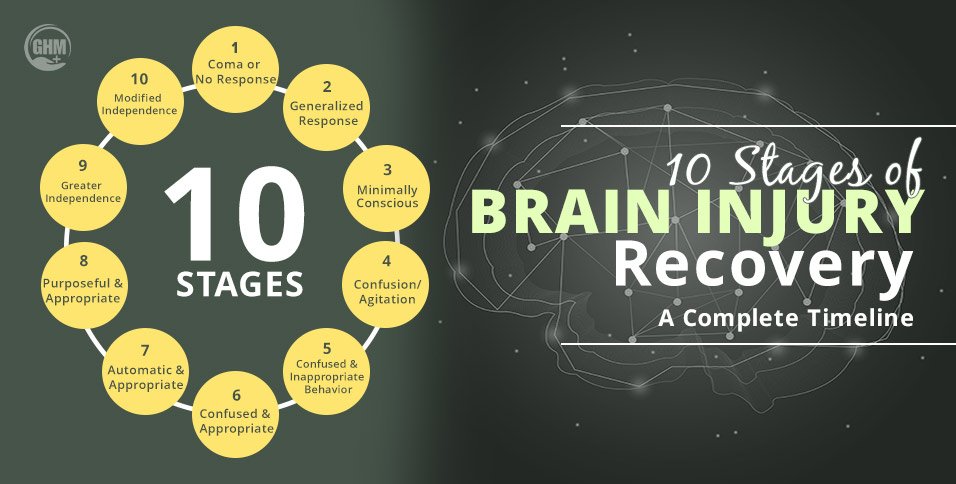
The brain injury recovery stages are divided into 3 phases: early stages, middle stages, and late stages.
Early Stages of Brain Injury Recovery
Stage 1: Coma or No Response
In this earliest phase of brain injury recovery, the patient experiences deep unconsciousness or severely reduced awareness. They show limited or completely absent purposeful responses to sights, sounds, or touch. In the 1st stage of TBI recovery, basic life needs require extensive medical and caregiver support, often including feeding tubes. Some patients may eventually begin showing signs of improvement as brain swelling subsides. In certain medical scenarios, doctors may use a medically induced coma to reduce dangerous pressure inside the skull.
Stage 2: Vegetative State or Generalized Response
During the vegetative brain injury recovery stage, patients may open their eyes, giving an outward appearance of wakefulness, but true purposeful awareness remains absent. Post-coma responses are strictly reflexive. Here, the patient might react inconsistently to loud noises, bright lights, or painful stimuli with changes in heart rate, breathing, or minor body movements. This phase signals that the brain is beginning to process sensory input, even if the patient is not yet fully conscious.
Stage 3: Minimally Conscious or Localized Response
The patient’s awareness begins to emerge during stage 3 of brain injury recovery. The patient drifts in and out of consciousness, displaying inconsistent but increasingly purposeful responses. They may begin following simple commands, such as blinking or squeezing a hand upon request, and start recognizing loved ones. During the 3rd stage of recovery, communication and recognition gradually improve as the brain continues to heal.
Stage 4: Post-Traumatic Amnesia and Confusion/Agitation
As patients wake further in the end of the early stage, they frequently experience post-traumatic amnesia (PTA). In PTA, the patient struggles to recall past events (retrograde amnesia) or form new memories (anterograde amnesia). In the middle stages of brain injury recovery, confusion, agitation, vocal outbursts, and volatile emotional changes are common because the patient feels deeply disoriented. This recovery phase requires a safe, calm environment, as patients often do not understand why they are hospitalized or that caregivers are trying to help.
Middle Stages of Brain Injury Recovery
Stage 5: Confused and Inappropriate Behavior
The patient is more alert during the 5th stage of brain injury recovery and can pay attention for short spans, but they remain heavily confused. While they can communicate, they often struggle to give relevant answers and may use objects incorrectly or invent fictitious memories (confabulation) to fill in memory gaps. Simple, structured activities during the brain injury recovery process, along with nd endless patience from caregivers, help manage the patient’s frustration and support cognitive re-engagement.
Stage 6: Confused and Appropriate
In the 6th stage of brain injury recovery, Goal-directed behavior begins to appear. The patient can carry out short conversations, follow multi-step instructions, and perform basic self-care routines like brushing their teeth. However, the patient’s memory and attention remain impaired. They easily become overwhelmed by changes in routine or busy environments. In the stages of brain injury recovery, safety awareness is often still limited therefore, supervision is still needed.
Stage 7: Automatic and Appropriate
At stage 7 of brain injury recovery, true independent rehabilitation routines begin. The patient can independently execute routine daily self-care and follow established schedules. Because physical functions look stable, patients often overestimate their abilities and believe they are entirely healed. However, they still struggle significantly with problem-solving, planning, and handling unexpected or unfamiliar situations.
Late Stages of Brain Injury Recovery
Stage 8: Purposeful and Appropriate
During stage 8 of brain injury recovery, memory and environmental awareness show marked improvement. Patients recognize their own cognitive limitations and actively develop compensation strategies to manage them. In the 8th TBI recovery stage, the patient functions independently in familiar settings and can interact socially, though complex or high-stress environments can still trigger poor judgment or emotional fatigue. Many patients transition from inpatient care back to their home environments during the last phase of brain injury recovery.
Stage 9: Reintegration and Greater Independence
During the reintegration phase of brain injury recovery, individuals manage everyday tasks with minimal assistance and often return to work, school, or community hobbies. While cognitive processing speed may still run slower than average, patients successfully utilize learned coping strategies to navigate daily life independently.
Stage 10: Modified Independence and Long-Term Management
The last phase, stage 10 of brain injury recovery, is the highest functional tier in the recovery framework. The individual achieves independence in living and daily decision-making, though subtle physical, emotional, or cognitive limitations may still persist. Long-term management strategies and ongoing adaptive habits help the brain injury survivor thrive despite lingering challenges.
Factors Affecting the Stages of Brain Injury Recovery
The speed of recovery after traumatic brain injury varies drastically; mild injuries may resolve in days, while severe trauma requires months or years.
Key factors influencing brain injury recovery timeline include:
- Severity: The depth and physical extent of initial trauma.
- Location: Specific functional areas of the brain affected.
- Duration of Unconsciousness: Longer comas often correlate with extended recovery timelines.
- Age and Health: Patient’s overall physical resilience prior to injury.
- Rehabilitation Quality: Consistency and personalization of professional therapies.
- Support Systems: Involvement of dedicated family members and structured home environments.
When brain injury recovery progress slows down, patients sometimes experience a plateau. However, a plateau does not mean improvement has stopped. Through neuroplasticity (the brain’s remarkable ability to reorganize itself and form alternative neural pathways), patients continue building new skills with consistent therapy.
Rehabilitation During Brain Injury Recovery
A multidisciplinary team of specialists is essential for guiding survivors through the stages of brain injury recovery.
Core brain injury rehabilitation disciplines include:
- Physical Therapy: Restores mobility, muscle strength, balance, and physical coordination.
- Occupational Therapy: Focuses on rebuilding independence in daily living activities like dressing, cooking, and bathing.
- Speech-Language Therapy: Addresses communication difficulties, cognitive-linguistic processing, and swallowing safety.
- Cognitive Rehabilitation: Targets attention, memory retention, reasoning, and executive functioning.
- Neuropsychological Assessment: Identifies specific cognitive strengths and behavioral challenges to refine treatment plans.
How Families Can Support Someone With a Brain Injury
Families are the big support network for brain injury survivors. To foster an encouraging healing environment:
- Maintain Predictable Routines: Keep the living space calm, quiet, and structured to prevent sensory overload.
- Communicate Clearly: Use short, simple sentences, speak slowly, and allow extra time for responses.
- Repeat Patiently: Reassure your loved one frequently regarding where they are and why they are receiving care.
- Document Progress: Take photos or keep a journal to look back on how far your loved one has traveled since day one.
- Protect Caregiver Health: Caregiver burnout is real. Seek professional counseling, lean on support groups, and accept help from friends to safeguard your own well-being.
Conclusion
Navigating a brain injury journey requires immense patience, resilience, and specialized medical guidance. While recovery paths are entirely unique to each individual, understanding the underlying stages of brain injury recovery transforms uncertainty into actionable hope.
If a loved one or someone you know is navigating a brain injury, hold on. With proper care and support, recovery becomes possible.
Frequently Asked Questions
- What are the chances of recovery from brain damage?
Chances of recovery from brain damage depend heavily on the severity of the injury, the patient’s age, and the affected area of the brain. Most people recover fully within three months, recovery from severe brain injury is harder to predict.
- What are bad signs after a head injury?
Dangerous red flag signs after a head injury include a worsening headache, repeated vomiting, seizures, and unequal pupils that require immediate emergency care.
- How to improve memory after a brain injury?
Improving memory after a brain injury involves using external reminder tools, practicing targeted daily habits, and working with health professionals