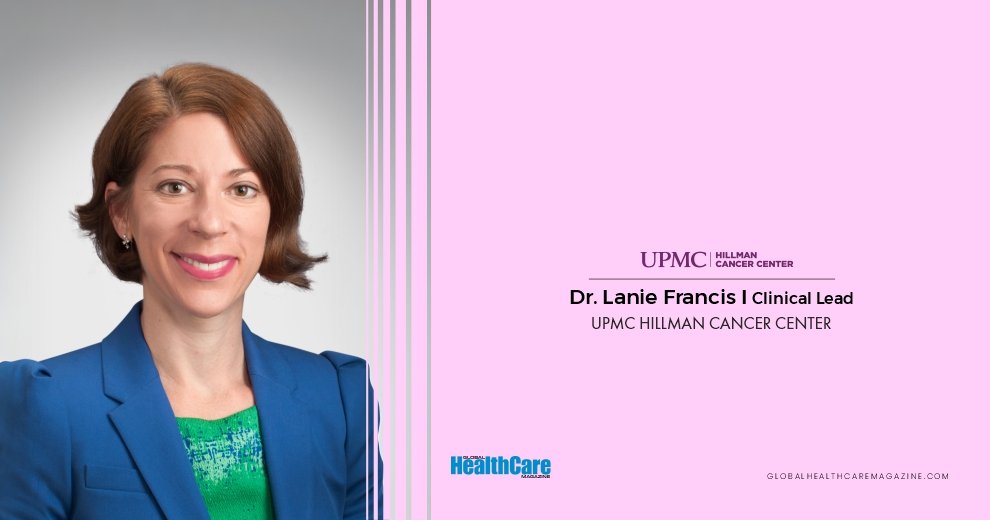
Somewhere in the space between a chemotherapy infusion and a follow-up scan, there is a version of cancer care that most oncology departments do not fully address: the version that asks how a patient is sleeping, whether they can still enjoy a meal, and what fear feels like at three in the morning. That space has become the professional territory of Dr. Lanie Francis, a physician who has spent more than a decade insisting that oncology cannot stop at the tumor.
Dr. Francis is board-certified in hematology and medical oncology and practices at UPMC Hillman Cancer Center, the flagship of UPMC’s cancer network in Pittsburgh, Pennsylvania. She treats solid tumors, particularly breast cancer, as well as blood disorders, and by her own account, her guiding interest has always been “treating the entire patient, body, mind and spirit.” “I am committed to authentic patient-centered care and shared decision-making,” she has said, a line that reads less like a mission statement and more like a description of how she has actually practiced for nearly two decades.
Thirteen Years at the Center of Hillman’s Cancer Program
Dr. Francis’s core clinical role, Medical Oncologist and Hematologist at Hillman Cancer Center, dates back to February 2013, a tenure now stretching thirteen years and seven months. Before that, she spent five years and four months, from October 2007 to February 2013, as a Medical Oncologist and Hematologist at UPMC Mercy, part of the same broader UPMC system.
Her research record includes serving as Principal Investigator for a phase III supportive-care trial examining a novel approach to managing nausea, alongside work as a sub-investigator on multiple clinical research studies at the University of Pittsburgh Cancer Institute (UPCI). Her peers have recognized her directly: she was selected as a Best Doctor and featured among Pittsburgh’s best doctors, and since March 2018, for eight years and six months, she has served under contract with Best Doctors, reviewing breast cancer and integrative oncology cases and authoring expert opinions.
Founding Wellness and Integrative Oncology
If there is a single achievement that defines Dr. Francis’s career, it is the program she helped build from the ground up. In April 2014, she became Founder and Director of the Wellness and Integrative Oncology Program at UPMC Hillman Cancer Center, a role she has now held for twelve years and five months. The program addresses, in her words, “the mind, body and spirit of cancer patients,” using evidence-based, symptom-directed care layered on top of conventional cancer treatment, with a subspecialty consult service that she personally leads, forming its clinical backbone.
The program has grown well beyond a single consult room. She and her team created a Nurse Ambassador Program, training oncology nurses to deliver integrative care, seated yoga, meditation, hand and foot massage, and aromatherapy, directly at the bedside or chairside. More than 40 nurses have been certified as nurse ambassadors across the UPMC system. UPMC Hillman Cancer Center’s ambulatory space now houses a dedicated Wellness Suite, offering acupuncture, oncology massage, aromatherapy, lifestyle nutrition, yoga therapy, and mindfulness within an integrated model of care. She is also associated with thisiskara.com, a mindfulness mobile website built specifically for cancer patients.
From Founder to Survivorship Lead
In July 2024, that foundation earned Dr. Francis a new leadership role, Clinical Lead of the Survivorship Program at UPMC Hillman Cancer Center, a role she has now held for two years and two months. The survivorship program, as she describes it, was re-envisioned around four pillars for every cancer survivor: exercise oncology, lifestyle nutrition, symptom management, and vigilant medical surveillance for recurrence or secondary malignancies. It is, in effect, the wellness and integrative philosophy she spent a decade building, now embedded within a broader institutional survivorship model.
An International Reach
Dr. Francis’s influence extends well past Pittsburgh. Since March 2014, for twelve years and six months, she has served as Associate Medical Director of Medical Oncology for UPMC International, a role in which she serves as a clinical advisor, assessing operations, training, and education for global cancer initiatives. Her work has taken her to Croatia, Italy, and Ireland on a consultative and training basis, and she has traveled more broadly to Latin America, Kazakhstan, and Russia over the past decade, with programming focused on medical oncology, international tumor boards, and case reviews across several countries.
Teaching, Public Service, and a Menopause Specialty
Dr. Francis is also an Assistant Clinical Professor at the University of Pittsburgh School of Medicine, a post she has held since May 2011, spanning fifteen years and four months. She teaches interviewing skills to first- and second-year medical students, conducts bedside teaching rounds with residents, mentors physician assistants and nurses, interviews prospective medical students, and serves on the school’s Promotions and Appeals Committee.
Her public service record includes appointments to the Commonwealth of Pennsylvania’s Medical Marijuana Advisory Board, as an inaugural member from September 2017 to May 2021, and later the Medical Marijuana Physician Working Group, from December 2020 to August 2024. More recently, she has become a Menopause Society Certified Practitioner, incorporating evidence-based menopause care into her work with cancer patients, one more example of a career built on refusing to treat any single aspect of a patient’s health in isolation.
Dr. Francis’s career reflects a simple conviction: survivorship should not be treated as an afterthought to cancer treatment. For nearly two decades, she has helped turn that belief into practice, developing integrative services, strengthening survivorship care, and making space for the physical, emotional, and practical needs that continue long after treatment ends. At UPMC Hillman, that work has become an established part of the way patients are supported beyond their diagnosis.