There is a woman on a stationary bike inside a care home in the Netherlands. The room around her is ordinary, as care home rooms tend to be. But the screen in front of her is showing a road in Hoogeveen, a small, unhurried Dutch town, and the sounds are right, and the images are moving because she is pedalling. Then she stops pedalling, and the route on the screen pauses with her, as though the world itself is waiting. She looks at something in the frame. A building, perhaps, or a corner she recognises from a long time ago. And then she shouts, with a certainty that cuts straight through the room: “Look! That’s where I bought my walker!”
This is not a story about an exercise bike. It is a story about what it costs a person to lose the small, ordinary things that made up their life, and what it means, in the most human sense possible, to find them again.
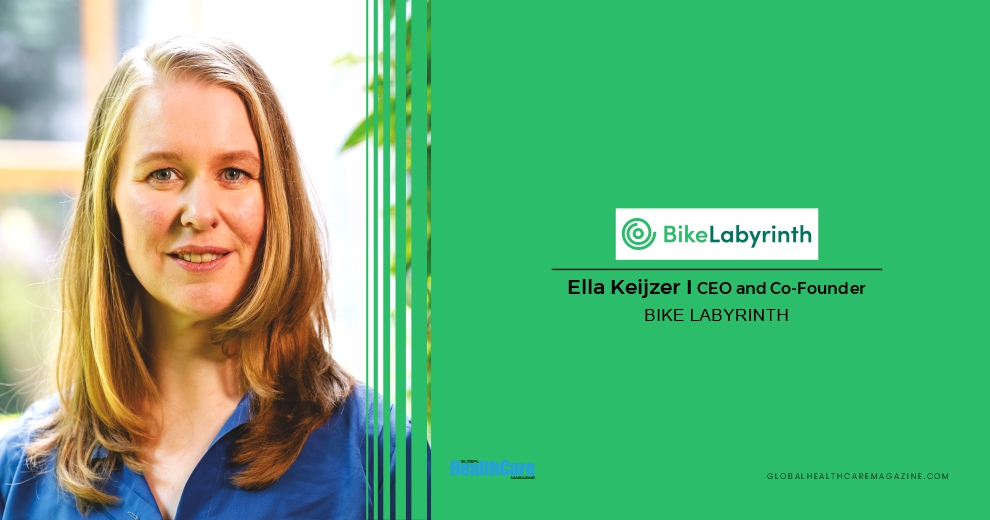
Ella Keijzer, CEO and co-founder of Bike Labyrinth, has spent fifteen years building toward exactly this kind of moment. Not the technology itself, not the hardware or the clinical certifications, but the moment: the one where someone who believed they had left something permanently behind discovers, with the full force of surprise, that they have not.
A Passing Grade That Changed Everything
The origin of Bike Labyrinth is the kind of story that almost resists being told plainly, because it sounds too tidy to be true. And yet it is entirely true.
In 2007, three students enrolled in a master’s programme in Media Technology set out to complete an assignment with a single, modest ambition: to pass the course. Their question was philosophical. They wanted to know whether people truly exercised free will or whether they simply followed the path of least resistance. To test this, they built a virtual cycling route through Leiden, the Netherlands, and presented their findings.
At that presentation, someone from the healthcare sector was watching. She did not see a philosophy project. She saw something her clients, elderly residents in a care home, had been quietly missing without anyone ever thinking to address it. She asked if she could have it. The students made a first pilot. And then, as students do, they returned to their degrees and their lives.
Four years passed. Then Ella Keijzer, together with her co-founder Job de Reus, decided to do something that most people would have considered impractical: take that university pilot, and build a real company around it. They started steadily in the Netherlands, then moved into Belgium, Germany, and, over the years that followed, into more than twenty countries across the world.
What drove the earliest customers was something intuitive and deeply Dutch. “The first customer who noticed the Bike Labyrinth pilot realised how much the elderly in her home missed cycling,” Ella explains. In the Netherlands, cycling is not a hobby so much as an identity. For residents who could no longer go outside independently, simply sitting on an exercise bike without any destination or motivation was not working. The routes changed that. Quickly, caregivers noticed that the routes were not only engaging but that they also opened conversations. They connected people. And for clients with dementia, those conversations were sometimes the only ones that happened all day.
The Product, and Why It Works
Bike Labyrinth now offers over 900 interactive virtual cycling routes, every one of them filmed and produced by the company’s own dedicated Film Team. These are not stock videos. The team travels across the world, cycling through cities, nature reserves, and small towns, filming each route in carefully planned segments that make the experience genuinely interactive. The sounds are recorded too: birdsong, street noise, wind moving through trees. Every detail is considered.
The screen on which the routes are displayed connects to an exercise bike or other exercise machine. When the cyclist pedals, the route moves. When they stop, it pauses. At intersections, a blue or yellow button on the steering wheel allows them to choose which direction to take. The cyclist has agency. That is not incidental to the design. It is the design.
In the Netherlands, where Bike Labyrinth is known as Fietslabyrint, the product is present in many of the nursing homes in the country. When senior officials from Singapore and Hong Kong visited recently, they assumed, quite reasonably, that only the most advanced institutions would have access to such technology. “When we told them it’s in almost every nursing home in the country,” Ella recalls, “they were stunned.”
The product holds CE marking and complies fully with the EU Medical Device Regulation. This certification, Ella says, is taken seriously not as a compliance exercise but as a statement of principle. The people using this product deserve that standard of rigour, and they should expect it.
What the Ride Actually Does
There are three misconceptions that Ella encounters regularly when speaking to caregivers and healthcare professionals, and she addresses each one with the calm, grounded certainty of someone who has spent fifteen years watching evidence accumulate.
The first is that physical activity becomes less important, or even risky, as a person ages or experiences cognitive decline. “In reality,” she says, “gentle, enjoyable physical activity is one of the most evidence-backed interventions we have for slowing cognitive decline and improving quality of life.”
The second misconception is subtler, and in some ways more damaging: that people with dementia cannot engage meaningfully with technology, or make genuine autonomous choices. Bike Labyrinth demonstrates the opposite every day. Given the right interface and the right content, people with significant cognitive impairment will actively select routes, respond to familiar landscapes, and initiate conversations that otherwise might never happen. “Agency doesn’t disappear,” Ella says. “It just needs the right conditions.”
The third is about motivation, and whether it matters clinically. What Ella and her team have found, consistently, is that when cycling feels like an outing rather than a therapy session, people do it more often, sustain it longer, and benefit more. “Intrinsic motivation is clinical infrastructure,” she says, and she means it not as a philosophical observation but as a practical finding.
When the body moves, the mind follows. Pedalling improves circulation, strengthens muscles, and supports balance, all without excessive strain on the body. But what distinguishes Bike Labyrinth is what happens alongside the physical activity. Cycling through a familiar landscape, or a once-loved holiday destination, produces something that no structured exercise programme tends to produce: memories surface, and with them, language. Someone who rarely speaks will suddenly have something to say, something specific and vivid and real.
The cognitive stimulation follows naturally. Navigating a route, noticing details in the landscape, tracking where you are, all of it keeps the mind engaged without feeling like work. And the whole experience, crucially, feels like an outing. One caregiver described what she witnesses after every session: residents and staff reviewing the ride together, talking about how far they went and what they saw along the way. “Then you see them beam,” she said. For someone who had believed they would never cycle again, that single moment matters more than any clinical metric.
Fifteen Years, Bootstrapped, and Global
Today, Bike Labyrinth is active in more than 4,000 care institutions across more than 20 countries, among them Germany, France, Belgium, Italy, Switzerland, Finland, Norway, Ukraine, the United States, Brazil, Hong Kong, and Singapore. The company employs a team of 25, with operations in the Netherlands and Germany and a reseller network that extends its reach into markets a team of that size could never reach independently. Current expansion efforts are focused on the United Kingdom, Singapore, and North America.
The Dutch team covers a remarkable breadth of disciplines in-house: Film, Research, Product development (encompassing both software and hardware), Sales, Operations, International Business, Project Management, Human Resources, and Marketing and Communication. Keeping these capabilities internal, Ella explains, is what allows Bike Labyrinth to guarantee quality at scale and to keep improving the product without depending on outside parties.
None of this growth has involved external investment. Bike Labyrinth has been bootstrapped from the beginning. Every decision has been made on the company’s own terms. This demands real discipline, but it also means the mission has never had to compete with investor timelines or external expectations.
The company’s impact has drawn significant international attention. In 2018, the New York Times featured Bike Labyrinth in a piece examining alternatives to medication in dementia care. Ella was interviewed live on BBC World News on the role of movement in supporting people living with dementia. She also participated in a trade mission to Japan alongside the Dutch Minister of Health, where the focus was on strengthening international cooperation in healthcare innovation and raising global awareness around dementia. At the 2024 Ageing Asia Innovation Forum, Bike Labyrinth received two Innovation of the Year awards, for Dementia Technology and for Technology Product, respectively. In the company’s most recent customer survey, care staff rated the product 8.6 out of 10.
There are quieter measures of impact, too. Wheelchair users from neighbouring care homes, institutions that did not yet have the system, began making their way to facilities that did, specifically to use Bike Labyrinth. That detail, more than any award or headline, says something plainly about what the product actually provides.
The Years That Tested Everything
Not every chapter of Bike Labyrinth’s story moves in a single direction. In 2022 and 2023, the company experienced two consecutive loss years. Growth was happening, but not sustainably. Ella was faced with some of the hardest decisions of her leadership: restructuring the organisation, sharpening the focus, and having the kinds of honest conversations that founders, in their more difficult moments, tend to avoid.
“The quality of a leadership team isn’t measured in the good years,” she reflects. “It’s measured in the moments when the path forward isn’t obvious.”
The organisation was rebuilt with clarity: clearer roles, clearer targets, and a shared methodology that the whole team could work within. By 2024, Bike Labyrinth had returned to profitability. Not because the market had shifted in their favour, but because the organisation itself had changed. It is the kind of outcome that does not happen easily or quickly, and Ella does not describe it as though it did.
A Leader Who Cycles to Work
Ella is a mother of two who runs an international company, and she does not pretend to have resolved the tension between those two things. “I don’t believe in perfect work-life balance,” she says plainly. “I’d be lying if I claimed I had it figured out.”
What she does instead is take care of herself sufficiently to keep going. She cycles to work every day. She practises yoga regularly, “because I notice when I don’t.” After fifteen years of witnessing, daily, what movement does for the people using her product, she says it would be strange not to take it seriously in her own life.
Outside of work, music matters to her in a way that feels genuine rather than incidental. She goes to concerts and makes music herself. She also grows apples and herbs. There is something in that detail, the patience it requires, the long-term attention, that feels consistent with someone who has spent a decade and a half growing something slowly, carefully, and on her own terms.
The Free Will Question, Revisited
It is worth returning, for a moment, to the very beginning: a philosophy question, posed by three students in 2007, tested with a virtual cycling route through Leiden. Ella has not let go of that origin. “Bike Labyrinth started as a philosophy experiment about free will,” she says. “That still feels relevant to how I lead.”
The original question was whether people make genuine choices or whether they simply follow the path of least resistance. What they found, and what Ella still believes, is that people make real choices when the conditions are right. Give someone genuine options and something genuinely worth choosing, and they will surprise you. She sees it every day in the people using her product. She applies the same thinking to how she runs her company.
“My job isn’t to have all the answers. It’s to build a team and an environment where good decisions get made without me needing to be in the room.” A company that only functions when the founder is present, she says without drama, is not a company.
The vision ahead is equally clear: a Bike Labyrinth on every exercise machine in every care institution in the world, not as an optional upgrade, but as the standard. Not because the market opportunity exists, though it does, but because Ella believes it should simply be considered normal: that elderly people in care continue to move, to choose, to remember, and to feel, even briefly, entirely like themselves.
Fifteen years in. Bootstrapped. Profitable. Still growing. And still, at the centre of all of it, a woman on a stationary bike in a care home somewhere in the Netherlands, suddenly recognising a street she once knew, and shouting about it with absolute certainty.
Quote
Also Read: CEOs of Tomorrow: The Leaders Reshaping Healthcare in 2026