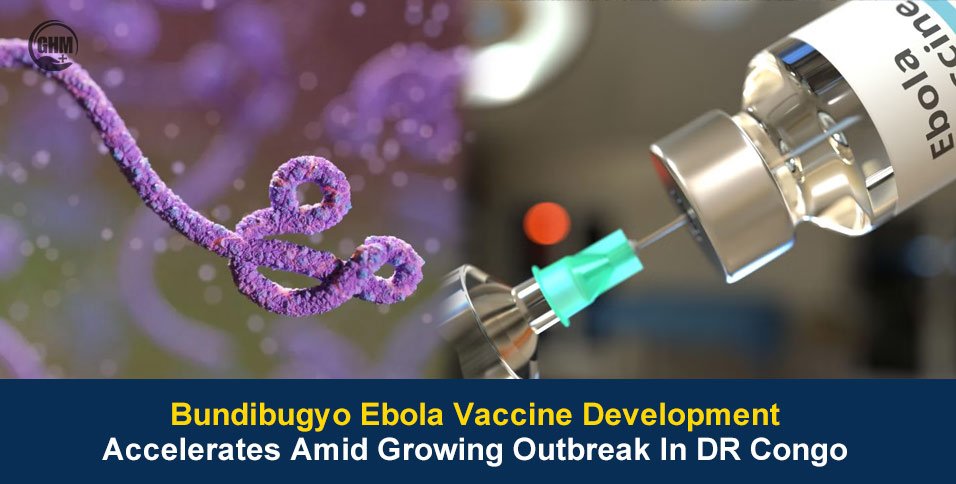
The global effort toward Bundibugyo Ebola vaccine development has entered a critical phase as international health organizations, governments, and vaccine developers mobilize funding and research resources to combat a rapidly expanding Ebola outbreak in Central Africa.
The outbreak, centered in the Democratic Republic of the Congo (DRC) and now affecting neighboring Uganda, has prompted urgent action from the World Health Organization (WHO), the Coalition for Epidemic Preparedness Innovations (CEPI), Gavi, vaccine manufacturers, and research institutions. With no approved vaccine currently available for the Bundibugyo strain of Ebola, experts are accelerating the development of several promising vaccine candidates while strengthening the broader Ebola outbreak response.
The recommendations for Bundibugyo Ebola vaccine development come as WHO continues to support authorities in the DRC and Uganda. Recent efforts have also built upon lessons from previous outbreaks, including those discussed during the WHO Director-General’s visit to the region.
Three Vaccine Technologies Leading Bundibugyo Ebola Vaccine Development
The WHO recently reviewed options for preventing and treating the Bundibugyo virus, emphasizing that all candidates must undergo carefully designed clinical trials. Three specific programs are leading the effort.
1. AVI’s Single-Dose rVSV Vaccine
The WHO identified IAVI’s rVSV-based vaccine as the most promising candidate currently under the Bundibugyo Ebola vaccine development.
The IAVI’s Single-Dose rVSV Vaccine uses the same platform technology behind Ervebo, the approved vaccine for the Zaire strain of Ebola. Preclinical studies have shown strong protection in animal models.
According to IAVI President and CEO Mark Feinberg, the organization is working urgently to prepare the vaccine for human testing. However, experts estimate that it may take seven to nine months before the candidate is ready for clinical evaluation.
2. Oxford and Serum Institute Advance ChAdOx1 Vaccine
A second promising Ebola vaccine candidate comes from Oxford University and the Serum Institute of India.
Built on the same platform used for the Oxford-AstraZeneca COVID-19 vaccine, the ChAdOx1 Bundibugyo vaccine could potentially enter efficacy studies within two to three months.
WHO experts noted that a single-dose version of the ChAdOx1 Bundibugyo vaccine could be suitable for people exposed to Ebola cases, while a two-dose approach may help protect healthcare workers and other high-risk groups.
3. Moderna Expands mRNA Ebola Vaccine Research
Moderna is developing an mRNA Ebola vaccine designed specifically for the Bundibugyo virus. The company recently secured up to $50 million in CEPI funding to support preclinical research, manufacturing, and Phase 1 testing.
Moderna Chief Executive Officer Stéphane Bancel said the company would move with urgency while maintaining rigorous safety standards.
The project builds on the same mRNA technology that enabled rapid COVID-19 vaccine development and could offer advantages in manufacturing speed and scalability.
CEPI To Fund Three Ebola Bundibugyo Vaccine Candidates
One of the most significant developments in recent days is the Coalition for Epidemic Preparedness Innovations (CEPI) decision to accelerate funding for three leading Ebola Bundibugyo vaccine candidates.
CEPI has announced support for vaccine programs led by:
- IAVI
- Moderna
- Oxford University in partnership with the Serum Institute of India
CEPI Chief Executive Officer Richard Hatchett described the situation as a race against time. “With Bundibugyo virus spreading rapidly and no licensed vaccines, every day counts in the race against this deadly disease.”
CEPI’s investment in multiple vaccine technologies increases the chances that at least one candidate can move quickly into large-scale vaccine testing and eventual deployment.
Gavi to Support Ebola Vaccine Access With $50 Million Funding
Alongside research investments, Gavi has announced up to $50 million in emergency funding to strengthen outbreak preparedness and future vaccine access.
The Vaccine Alliance plans to allocate:
- Up to $40 million for Ebola vaccine manufacturing and procurement readiness.
- $10 million for immediate outbreak response activities.
Gavi CEO Sania Nishtar emphasized the importance of preparing vaccine production capacity before clinical trial results become available.
The funding for the Ebola outbreak from Gavi may support Advance Purchase Commitments and other mechanisms designed to ensure rapid access if vaccine candidates prove safe and effective.
Ebola Outbreak in Congo Raises Global Concern
The current Ebola outbreak in Congo is particularly concerning because Bundibugyo virus has caused only two previous outbreaks since its discovery.
Health officials report growing numbers of suspected infections and deaths, while confirmed cases have already crossed international borders into Uganda.
Several factors are complicating containment efforts:
- Ongoing insecurity in affected African regions.
- Limited healthcare infrastructure.
- Difficulties with contact tracing.
- Population movement across borders.
Public health experts warn that swift intervention is essential to prevent further spread and reduce mortality.
Conclusion
Alongside Bundibugyo Ebola vaccine development, researchers plan to evaluate investigational treatments. These include therapeutics like MBP134, Maftivimab, and remdesivir, as well as post-exposure prevention using the antiviral drug obeldesivir.
WHO, Africa CDC, CEPI, Gavi, national governments, and vaccine developers are coordinating efforts to accelerate clinical research while maintaining strict safety and ethical standards. If successful, these vaccines could not only help control the current outbreak but also strengthen global preparedness against future Ebola emergencies.
As Bundibugyo Ebola vaccine development advances at an unprecedented pace, for now, traditional public health measures, including surveillance, rapid testing, contact tracing, patient isolation, and community engagement, remain the frontline defense against transmission.