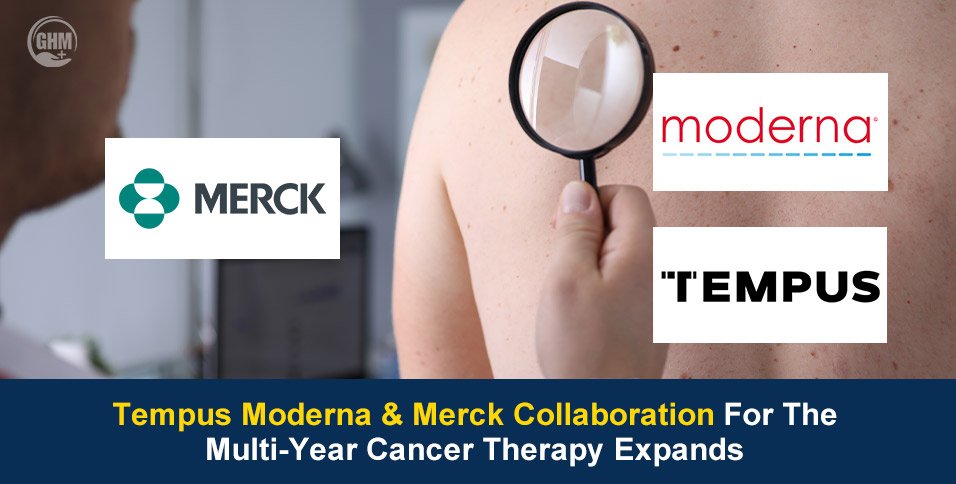
The Tempus Moderna & Merck collaboration has expanded into a multi-year agreement to support the potential commercialization of intismeran autogene, an investigational individualized cancer therapy.
The cancer treatment is being developed jointly by Moderna and Merck and evaluated with KEYTRUDA (pembrolizumab) in patients with completely resected stage IIB-IV melanoma and other cancers.
Tempus will manage tumor tissue and blood sample collection and transfer and provide next-generation sequencing (NGS) services to support the cancer therapy’s design and manufacturing.
What Is Tempus Moderna & Merck Collaboration?
The expanded Tempus Moderna & Merck collaboration builds on work the companies began in 2025. Under the agreement, Tempus will help establish the diagnostic and sequencing infrastructure required to move an individualized therapy from clinical development toward potential commercialization.
The Tempus cancer vaccine collaboration includes:
- Collection and timely transfer of tumor tissue and blood samples.
- Next-generation sequencing of patient samples, subject to regulatory approvals.
- Sequencing support for the design and manufacturing of intismeran autogene.
- Operational support for an individualized treatment workflow.
Financial terms were not disclosed for the Tempus Moderna & Merck collaboration.
Said Francis, Moderna’s chief business officer and general manager of Individualized Neoantigen Therapies, said an individualized treatment requires a seamless, highly reliable diagnostic network as it moves toward potential commercialization.
“Working with Tempus allows us to leverage their commercial footprint and advanced sequencing capabilities as we work to deliver individualized neoantigen therapies to patients at scale.”
What Is Intismeran Autogene?
Intismeran autogene is an investigational mRNA-based individualized neoantigen therapy. It uses information from a patient’s tumor to identify its unique mutation pattern and help generate an immune response against cancer.
According to Merck and Moderna, each treatment can contain mRNA coding for up to 34 neoantigens, with the therapy tailored to the biology of the individual tumor.
The therapy remains investigational. Although the companies plan to engage with regulators regarding potential submissions, it has not yet received regulatory approval for commercialization.
How Tempus NGS Services Could Support the Cancer Therapy?
The intismeran autogene is designed around the genetic characteristics of an individual patient’s tumor, which makes Tempus NGS services significant.
NGS is a technology that allows researchers to analyze large amounts of genetic information from biological samples. For an individualized neoantigen therapy, tumor sequencing can help identify mutations that distinguish a patient’s cancer.
The broader tumor sequencing process requires several steps:
Tumor sample → Genetic sequencing → Identification of tumor mutations → Individualized therapy design → Manufacturing
Tempus said its role will help create an end-to-end clinical workflow connecting sample collection, sequencing, therapy design and manufacturing. Its precision-medicine platform also uses artificial intelligence and multimodal healthcare data to support personalized care and therapeutic development.
While Moderna contributes its mRNA technology, Merck brings its oncology expertise and KEYTRUDA platform.
What Are The Trial Results For Moderna and Merck Cancer Therapy?
The Moderna and Merck cancer therapy has gained momentum following positive Phase 3 results announced in August.
Merck and Moderna reported that the Phase 3 trial, INTerpath-001, met its primary endpoint of recurrence-free survival (RFS) and a key secondary endpoint of distant metastasis-free survival (DMFS) in patients with completely resected stage IIB-IV melanoma. The study compared intismeran autogene plus KEYTRUDA with KEYTRUDA alone.
The trial enrolled 1,137 patients and is continuing to evaluate other outcomes, including overall survival. Merck and Moderna said the combination produced statistically significant and clinically meaningful improvements in RFS and DMFS at a prespecified interim analysis. No new safety signals were reported.
Earlier five-year follow-up data from a Phase 2b study showed a 49% reduction in the risk of recurrence or death and a 59% reduction in the risk of distant metastasis or death compared with KEYTRUDA alone.
Why the Tempus Cancer Vaccine Collaboration Is Significant?
The expanded Tempus Moderna & Merck collaboration highlights the infrastructure challenges involved in delivering personalized cancer treatments at scale. Unlike conventional medicines produced as standardized products, an individualized therapy requires patient-specific biological samples, genetic analysis, and coordinated manufacturing.
The development also follows Tempus’ broader expansion in cancer diagnostics and monitoring, with its recent acquisition of Personalis.
With the Tempus Moderna & Merck collaboration, the companies now face the next stages of clinical development, regulatory engagement, and commercialization preparation. The expanded partnership does not guarantee approval, but it represents a significant effort to build the diagnostic and sequencing network that an individualized cancer therapy may require.