You glance up at a bright blue sky or a blank white wall, and something drifts across your vision. Well, you are not imagining things. Those are eye floaters.
Not all eye floaters are the same. There are different types of eye floaters. A wispy thread, a tiny dot, a shadowy cobweb that disappears when you try to look directly at it. Some floaters in vision are completely harmless, a natural part of aging. Others can be early warning signs of a serious eye condition that needs immediate attention. Knowing the difference could save your vision.
Studies show that up to 76% of people report seeing floaters at some point in their lives, yet most people have no idea why they appear or what the different shapes of eye floaters mean.
This guide explains exactly what the different types of eye floaters look like, why they develop, and most importantly, when eye floaters are serious and when they are not.
What Are Eye Floaters?
Eye floaters are tiny shapes or shadows that drift across your field of vision. Floaters in the eye may look like specks, squiggly lines, threads, cobwebs, or hazy clouds, and they tend to move when your eyes move, then slowly drift away when you stop. In medical terms, floaters are called myodesopsia.
The vitreous humor is a clear, gel-like substance that fills the inside of the eye and gives it its round shape. Floaters form inside the vitreous humor. When a person is young, this gel is smooth and transparent. With age, it gradually becomes more liquid and starts to shrink. Tiny fibers and protein clumps form inside the gel, and when light passes through the eye, these clumps cast shadows on the retina (the light-sensitive layer at the back of the eye). Those shadows are what a person sees as floaters.
Floaters in the eye are most noticeable while looking at a bright, uniform background, like a clear sky, a white sheet of paper, or a well-lit room.
What Are The Types of Eye Floaters?
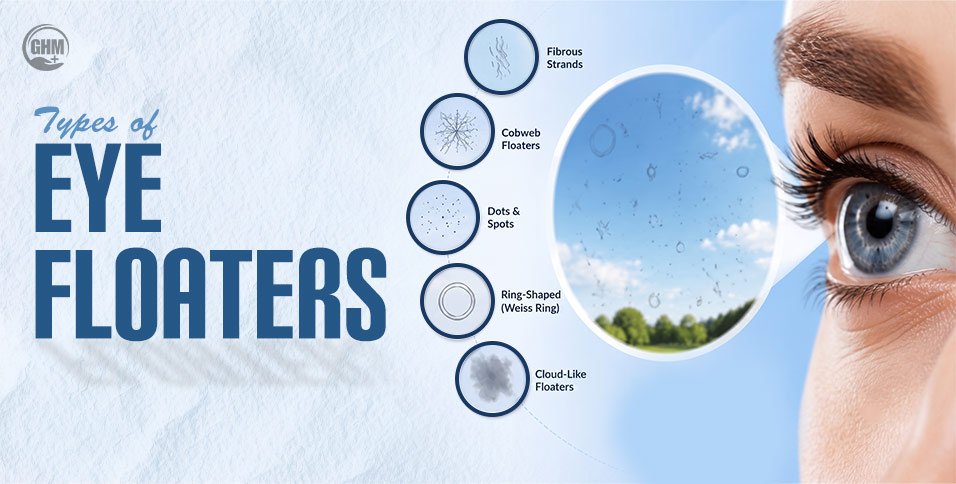
Eye floaters come in several distinct shapes and forms. The types of eye floaters are fibrous strands, cobweb patterns, dots and spots in eyesight, ring-shaped floaters, and cloud-like hazes.
Each eye floater indicates a different sign. Understanding the different types of eye floaters can help in recognizing when something may need medical attention.
1. Fibrous Strand Floaters
Fibrous strand floaters appear in the vision as thin, thread-like lines or wavy strands that drift slowly across the vision. Fibrous strands are one of the most common types of eye floaters and develop when collagen fibers inside the vitreous gel begin to clump together.
Fibrous strand floaters are most noticeable against bright, light-colored backgrounds, and they tend to move in a slow, flowing pattern. These thread-like floaters are generally harmless and associated with the natural aging of the vitreous.
2. Cobweb Floaters
Cobweb floaters look like branching, web-shaped patterns, similar to a spider’s web floating in your line of sight. They form when multiple clumped collagen fibers tangle together, creating a larger and more intricate structure.
Because of the size and irregular shape of cobweb floaters, they can feel more distracting than smaller floaters. Cobweb floaters in the eye are particularly common in people experiencing age-related vitreous changes.
3. Dot and Spot Floaters
Floaters like dots and spots are small, rounded dark specks that appear in the vision. They are typically caused by clusters of protein deposits or cellular debris within the vitreous humor.
Dot and spot floaters are among the most frequently reported eye floater types and are strongly associated with the natural aging process. While eye floaters can be annoying, they are usually not a sign of anything serious unless they appear suddenly and in large numbers.
4. Ring-Shaped Floaters (Weiss Ring)
The floater appears in a circular or oval shape and looks like a Weiss ring or loop floating in the vision. It forms when the vitreous gel detaches from the optic nerve head (the point where the optic nerve connects to the retina), leaving behind a ring-shaped impression.
The Weiss ring is directly linked to posterior vitreous detachment (PVD), a condition that becomes increasingly common with age. If someone notices a sudden ring-shaped floater, it is important to see an eye doctor promptly to rule out any associated retinal problems.
5. Cloud-Like Floaters
Cloud-like floaters appear as hazy, smoky, or semi-transparent patches that drift across your visual field. They tend to develop from large clusters of microscopic particles in the vitreous and can reduce visual clarity more than smaller floaters.
While they are often benign, very dense cloud-like floaters can sometimes indicate inflammation or bleeding within the eye, both of which require professional evaluation.
What Causes Different Types of Eye Floaters?
Eye floaters do not form randomly. Several health conditions can be causes of eye floaters:
1. Age-Related Vitreous Changes
Age-related vitreous changes are the most common cause. Over time, the vitreous gel undergoes a process called syneresis, which gradually liquefies and shrinks. As this happens, collagen fibers that were evenly distributed begin to aggregate and clump, casting shadows that appear as floaters. This process begins in middle age and accelerates over time.
2. Posterior Vitreous Detachment (PVD)
PVD is the natural separation of the vitreous gel from the surface of the retina. It is the most common cause of new floaters in adults over 50. Prevalence of PVD rises significantly with age, affecting around 63% of people over 70 and up to 87% of those aged 80–89. PVD itself is not sight-threatening, but it can occasionally cause retinal tears if the separating vitreous pulls on the retina.
3. Inflammation Inside the Eye
Conditions such as uveitis (inflammation of the uvea, the middle layer of the eye) can release inflammatory cells and debris into the vitreous, which appear as floaters. These inflammation-related eye floaters often accompany other symptoms such as eye redness, pain, or light sensitivity.
4. Bleeding Within the Eye
Vitreous hemorrhage, bleeding into the vitreous cavity, can cause a sudden shower of dark floaters. This may result from retinal tears, diabetic eye disease, trauma, or complications of certain medications. Bleeding-related eye floaters often appear as numerous dark spots or a reddish haze and are always a medical emergency.
5. Nearsightedness (myopia)
People with myopia are 3.5 times more likely to experience eye floaters on moderate to severe levels. The elongated shape of a nearsighted eye places extra mechanical stress on the vitreous, accelerating its degeneration, causing eye floaters.
6. Diabetes-related eye disease (diabetic retinopathy)
Individuals with diabetes are at risk due to changes in the blood vessels inside the eye, which can lead to bleeding or inflammation that generates eye floaters.
When Do Eye Floaters Require Immediate Medical Attention?
While most eye floaters are benign, certain changes in the eye floaters or new symptoms alongside them require urgent evaluation. Do not wait for a routine appointment if you experience any of the following:
1. Sudden Increase in Floaters
A rapid shower of new spots or strings appearing all at once, especially if you have never experienced floaters before, is a red flag. This can signal a retinal tear or the onset of posterior vitreous detachment with complications, both of which need same-day assessment.
2. Flashes of Light
Seeing flashes of light in the eye, particularly brief streaks or lightning-like flickers, usually at the edge of the vision, often means the vitreous is pulling or tugging on the retina. This retinal traction can precede a retinal tear.
3. Vision Loss or a Curtain-Like Shadow
If the vision becomes suddenly blurry, or a gray or dark shadow appears across part of the visual field like a curtain or veil, this may indicate retinal detachment. Retinal detachment is a medical emergency that can lead to permanent vision loss if not treated within hours.
4. Peripheral Vision Changes
Any loss of side (peripheral) vision alongside floaters should never be ignored. It can indicate that the retina has already begun to detach. Seek urgent ophthalmic evaluation immediately.
If you experience any of these warning signs, go to an emergency eye clinic or hospital immediately. Do not wait.
Conclusion
Most types of eye floaters are harmless and simply part of the natural aging process, fading into the background over time as your brain adapts. Treatment is generally not required for floaters that are mild, stable, and not affecting your daily life.
What matters most is knowing when floaters are trying to tell you something important. A sudden surge of new floaters, flashing lights, or any change in your peripheral vision is never a symptom to dismiss. These warning signs demand prompt medical evaluation, because when it comes to your retina, early action is the difference between full recovery and permanent vision loss.
Make regular eye examinations a habit. They are the single most reliable way to monitor your eye health, catch silent changes early, and protect your vision for the long term.
Sanskruti Jadhav