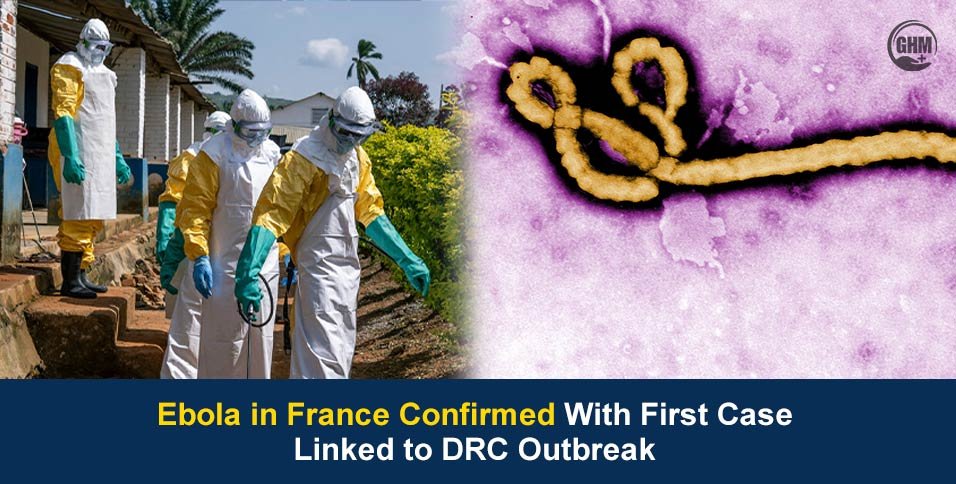
The French Health Ministry announced that the humanitarian doctor who recently returned from a mission in the Democratic Republic of the Congo (DRC) carries the Ebola virus, confirming the first case of Ebola in France.
Upon arrival, the doctor was quickly placed into a specialized high-containment infectious disease facility. This development marks the first confirmed Ebola cases in France linked to the African health crisis. However, global health agencies emphasize that the risk of widespread public transmission in Europe remains exceptionally low.
The Ebola outbreak in DRC has raised international concern due to its rapid expansion with nearly 1000 cases. However, French authorities reassure the public that strict protocols are already active to prevent any further local transmission.
How the Ebola in France Was Detected
The infected medical professional had been volunteering in the northeastern regions of the DRC, the epicenter of the current African crisis. Shortly after arriving back in France, the doctor exhibited symptoms consistent with the virus.
Because France maintains dedicated capabilities for highly transmissible pathogens, the first Ebola patient in France was immediately isolated. The patient was transferred to a designated healthcare facility featuring negative-pressure rooms and specialized biosafety protocols. French Health Minister Stéphanie Rist confirmed that the rapid detection of the virus allowed emergency protocols to minimize potential community exposure instantly.
France’s Rapid Response to Ebola Spread
To stop the spread of the Ebola virus in France, epidemiological teams launched an aggressive contact-tracing campaign.
The Ebola containment measures in France include:
- Flight Mapping: Authorities successfully traced five passengers who sat in close proximity to the doctor during the flight to France, placing them into immediate isolation.
- Quarantine Protocol: All identified close contacts are required to undergo a mandatory 21-day home isolation period.
- Continuous Monitoring: Regional health agencies are conducting daily health checks on these individuals throughout the incubation window.
The French Health Ministry explicitly stated that there is currently absolutely no evidence of local or community-level spread within the country.
Risk of Ebola Outbreak in France Remains Low
Global health organizations have urged the public to remain calm rather than panic. World Health Organization (WHO) Chief Tedros Adhanom Ghebreyesus remarked that over the past 50 years, fewer than 30 Ebola cases have ever been detected outside of Africa.
“The risk is low, whether it’s France or other countries in Europe, they shouldn’t overreact,” Tedros advised during a press briefing.
Furthermore, the European Centre for Disease Prevention and Control (ECDC) classified the risk to the general European population as “very low”. This low risk is due to how Ebola spreads: the virus requires direct contact with infected bodily fluids (such as blood, vomit, or sweat) and cannot be transmitted through casual, airborne contact like the flu.
Ebola Outbreak in DRC Keeps Worsening
The current situation inside the DRC remains severe. The United Nations warned that this particular event is the fastest-growing outbreak in Africa’s history.
Data from the DRC Health Ministry shows that as of June 21, 2026, there have been 1,048 confirmed infections and 267 deaths. A US Centers for Disease Control and Prevention (CDC) analysis suggests the virus may have been spreading undetected since mid-February. Response efforts in Africa are heavily challenged by local misinformation, community distrust, and active regional conflicts.
Global Health Experts Urge Vigilance
A major concern for scientists tracking this outbreak is the specific variant involved: the rare Bundibugyo virus strain.
Unlike the more common Zaire strain, the Bundibugyo strain currently has no approved vaccine or specific antiviral treatment available. However, a vaccine for the Bundibugyo strain is in the process of development with the involvement of global institutions such as the WHO and various vaccine manufacturers. But it could take months to finish.
What Happens Next?
Even though the detection of Ebola in France is reason to panic, thanks to the swift response of isolation of the patient and comprehensive contact tracing, the threat to the wider public remains very low.
In the coming weeks, French medical teams will continue monitoring the isolated contacts until they clear the 21-day mark. Meanwhile, international efforts remain focused on containing the outbreak at its source in the DRC by scaling up laboratory testing capacities and restoring community trust in healthcare workers.